Building for Payment Provider Downtime: Failover Strategies That Actually Work
Reliability Starts Before Failure Happens
Many platforms approach failover as a backup plan. In practice, failover is an architecture.
A secondary provider alone does not solve resilience. The real challenge is deciding when to reroute traffic, how transactions should behave during instability, and how to preserve transaction integrity while systems degrade under pressure.
This is where many payment stacks become fragile.
Retries trigger duplicate requests. Settlement states become inconsistent across providers. Finance teams lose visibility into which transactions are actually completed. Customers see delayed confirmations while operations teams investigate multiple dashboards trying to reconstruct payment flows manually.
The problem is rarely a single outage.
It is the absence of coordinated failure design.
Why Simple Failover Logic Fails
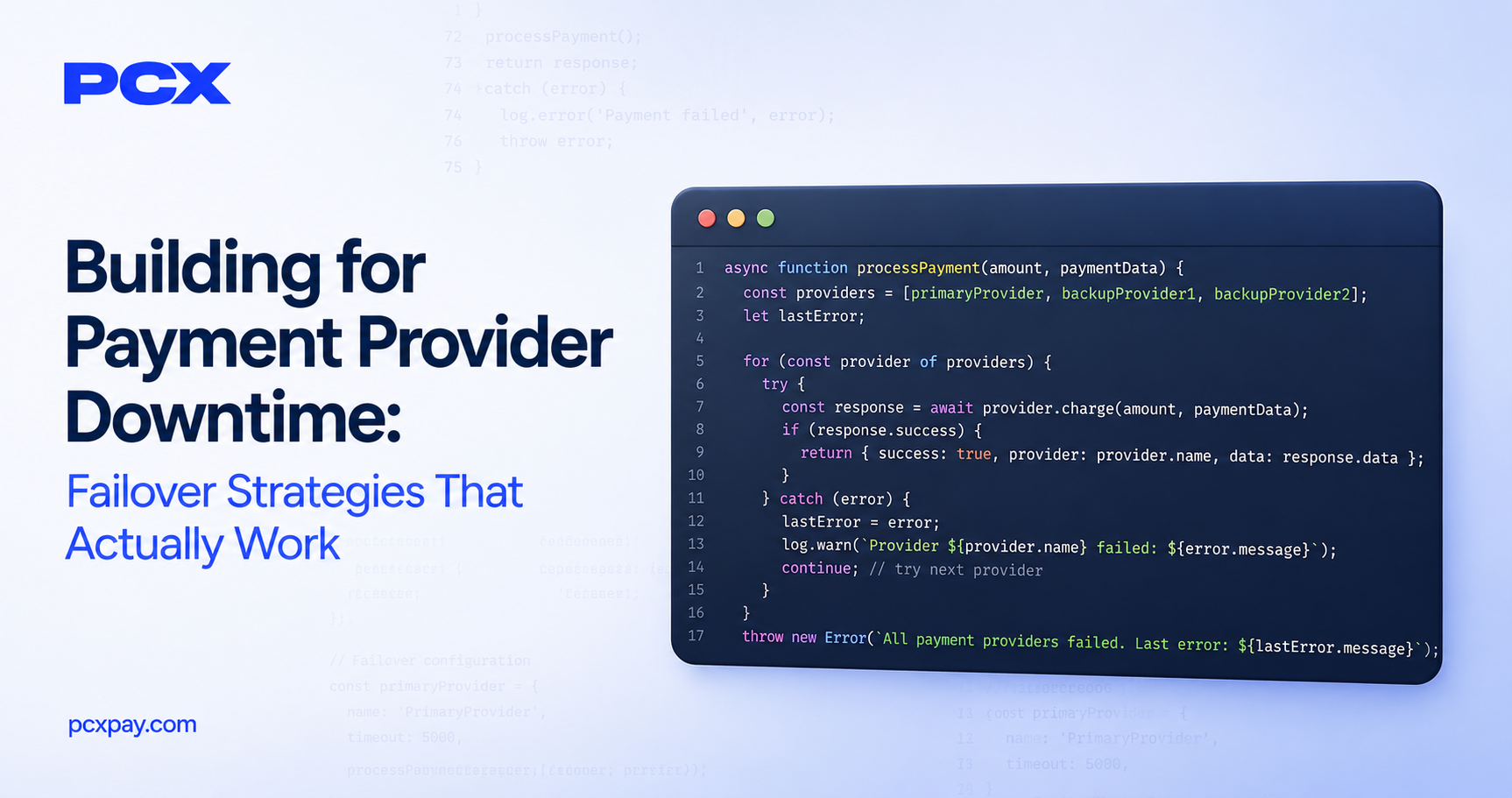
Basic failover systems rely on static rules.
If Provider A fails, switch traffic to Provider B.
But payment infrastructure does not behave that cleanly in real environments. One provider may process card payments successfully while bank transfers degrade. A corridor may remain operational in one country while settlement delays appear in another. Liquidity conditions may shift faster than static routing rules can respond.
Effective failover requires contextual routing intelligence.
At PCXPay, routing systems continuously evaluate transaction conditions across partner health, settlement latency, corridor performance, and provider responsiveness in real time. Instead of waiting for complete outages, infrastructure can gradually reduce exposure to unstable rails before transaction failure rates escalate system-wide.
The objective is not simply rerouting traffic.
It is maintaining predictable transaction outcomes while infrastructure conditions change underneath the system.
Graceful Degradation Matters More Than Perfect Uptime
The strongest payment systems are not the systems that never fail.
They are the systems that fail predictably.
Graceful degradation allows infrastructure to reduce non-essential functionality while protecting core transaction integrity. Low-priority processes can be deferred. Secondary services can temporarily scale down. Critical payment flows continue operating through alternate settlement paths without exposing instability directly to end users.
From the customer perspective, the experience remains consistent even while the infrastructure adapts aggressively behind the scenes.
This distinction matters because users do not evaluate payment architecture based on uptime percentages.
They evaluate whether money arrives correctly and on time.
Infrastructure Visibility Changes Everything
Failover only works when systems can observe failures clearly.
Without transaction visibility, teams cannot distinguish between provider instability, settlement delays, routing failures, or reconciliation mismatches. Operations teams become reactive instead of proactive.
Modern payment infrastructure requires observability across the full transaction lifecycle, not just API availability monitoring.
At PCXPay, transaction orchestration is designed around real-time visibility into routing decisions, settlement behaviour, provider performance, and transaction-state consistency. This allows failover systems to respond dynamically instead of relying on rigid predefined assumptions.
As payment ecosystems become increasingly fragmented, resilience will depend less on having a single reliable provider and more on building infrastructure capable of adapting continuously under unstable conditions.
Because in modern payments, downtime is not the real risk.
Unprepared infrastructure is.
If your payment operations still depend on static provider failovers or manual escalation during outages, it may be time to rethink how resilience is designed into your infrastructure stack.
Learn how PCXPay approaches payment resilience through adaptive routing, transaction observability, and infrastructure designed for real-world payment volatility.