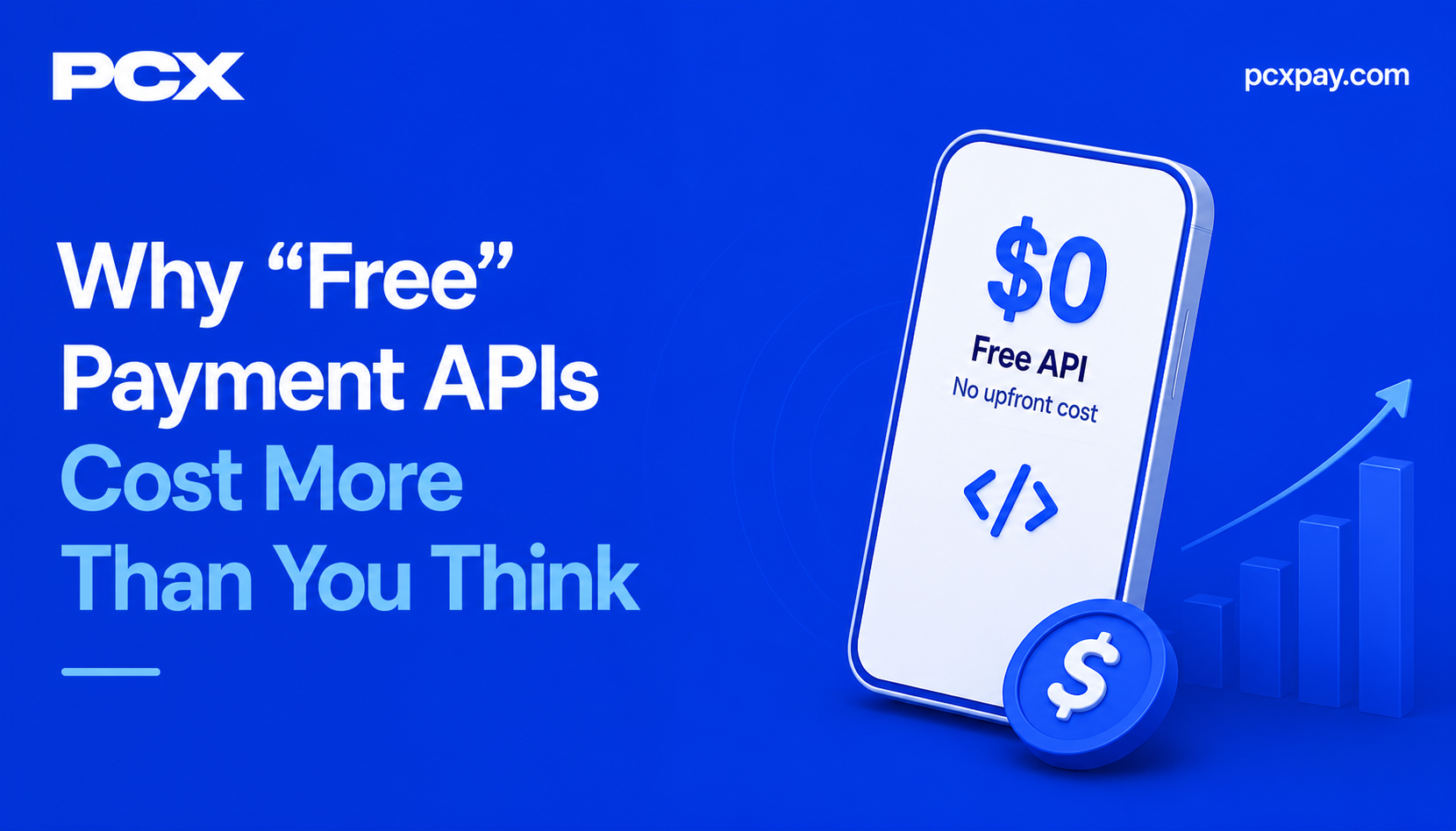
Why "Free" Payment APIs Cost More Than You Think
The Illusion of Simplicity
Most payment APIs are designed to feel frictionless during onboarding.
Documentation looks clean. Integration guides appear straightforward. Demo transactions succeed instantly. Early transaction volume flows smoothly enough that teams assume the hard part is solved.
What often remains hidden are the operational dependencies attached beneath the surface.
Many providers rely heavily on layered partner networks, corridor dependencies, liquidity intermediaries, or regional banking relationships that customers never fully see during integration. At low volume, these abstractions hold together reasonably well.
At scale, the cracks begin to appear.
Settlement delays emerge across certain corridors. Routing reliability fluctuates during peak periods. Support escalations increase whenever downstream partners experience instability. Engineering teams suddenly discover they have limited visibility into how transactions are actually moving beneath the API layer.
The integration was free.
The operational complexity was not.
The Hidden Hooks Behind "Free"
In many cases, the real cost appears through commercial constraints rather than technical ones.
Minimum transaction commitments quietly shape platform decisions long after integration is complete. Exclusivity clauses limit flexibility when businesses want to expand into new regions or diversify providers. Pricing structures that initially appear competitive become expensive once FX spreads, payout fees, settlement delays, or routing inefficiencies accumulate at scale.
Then comes integration debt.
Every payment provider introduces its own transaction models, reconciliation formats, webhook structures, and compliance workflows. Replacing or expanding beyond that provider later often requires significant engineering effort because the business logic becomes tightly coupled to one ecosystem.
What looked like speed early on eventually becomes infrastructure lock-in.
At PCXPay, infrastructure decisions are approached with long-term operational flexibility in mind. Routing architecture, settlement visibility, and reconciliation systems are designed to reduce dependency concentration while maintaining adaptability across changing payment environments.
Because resilient infrastructure is not defined by how easy it is to start.
It is defined by how sustainable it remains under scale.
Cheap Integration, Expensive Operations
The most expensive payment infrastructure problems rarely appear during onboarding.
They emerge later through failed settlements, fragmented reporting, routing instability, compliance bottlenecks, and growing operational overhead that internal teams must absorb manually.
This is why many companies eventually realise that the cheapest API was not actually the lowest-cost decision.
The true cost of payment infrastructure is measured over years of operational scale, not the first week of integration.
If your payment stack depends heavily on manual workarounds, limited routing visibility, or infrastructure that becomes harder to adapt as you grow, it may be time to evaluate the hidden cost beneath the "free" label.
Learn how PCXPay approaches payment infrastructure with scalability, flexibility, and operational resilience built into the foundation.