Embedded Finance for Non-Fintechs: What SaaS and Marketplace Founders Need to Know Before They Start
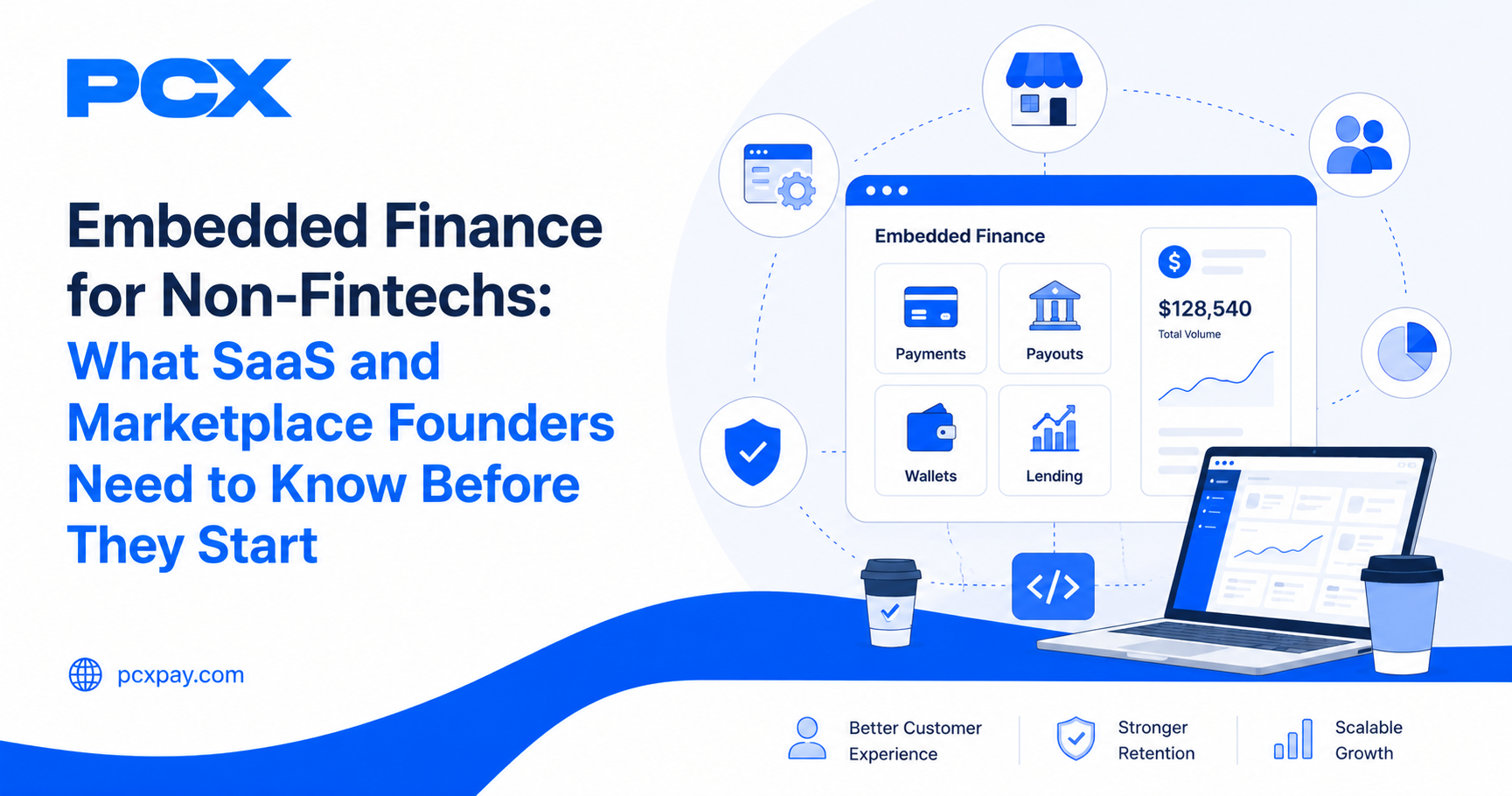
Add payments. Enable payouts. Maybe introduce wallets. Improve user experience.
For many SaaS and marketplace founders, it feels like a natural extension of the product.
Until it isn't.
Because the moment financial flows become part of your platform, you are no longer just building software. You are operating within a financial system with real consequences tied to every transaction.
The complexity is not obvious at the start. It shows up as you scale.
The Shift from Feature to Infrastructure
In non-fintech products, payments are often introduced as a feature.
A marketplace wants to pay vendors. A SaaS platform wants to charge customers more efficiently. A platform adds a payment API and moves on.
At low volume, this works.
But embedded finance is not just about enabling transactions. It is about managing the full lifecycle of money as it moves through your system. Collection, storage, routing, conversion, settlement, and reconciliation all become part of your responsibility.
This is where the shift happens.
What started as a feature becomes infrastructure.
And infrastructure behaves differently. It requires consistency, visibility, and control across every transaction, not just successful ones.
What Founders Often Underestimate
The early focus is usually on integration.
How quickly can we go live? How simple is the API? How smooth is the checkout experience? Those are important. But they are not where most problems come from.
The real complexity sits beneath the surface.
Transactions do not move in a straight line. They pass through multiple systems. Payment processors, banking partners, compliance checks, and settlement layers all interact in ways that are not always visible from the product layer.
At scale, small inconsistencies compound.
A delayed settlement affects cash flow. A failed payout creates support overhead. Incomplete transaction data makes reconciliation harder. Compliance checks interrupt flows at unpredictable points.
None of these issues are visible in a demo.
All of them are visible in production.
Cross Border Reality Changes Everything
For platforms operating across markets, complexity increases quickly.
Different regions introduce different regulatory requirements, payment methods, and settlement timelines. A flow that works in one country may fail in another. Costs vary by corridor. Currency conversion introduces additional variables.
This is where many non-fintech platforms hit a wall.
They build for a single market, then try to extend the same system globally. The result is fragmentation. Multiple providers. Inconsistent reporting. Operational overhead that grows faster than revenue.
Embedded finance becomes harder to manage than expected.
Designing for What Comes Next
The platforms that succeed with embedded finance do not treat it as an add-on.
They design for it as a system from the beginning.
That means thinking beyond API calls.
How will transactions be tracked end to end? How will reconciliation work at scale? How will compliance requirements evolve across markets? How will settlement timelines affect cash flow?
These are not edge cases. They are the operating conditions of embedded finance.
At PCXPay, the focus is on abstracting these layers into a coordinated infrastructure. Payment routing, compliance, FX, and settlement are designed to work together so platforms do not have to manage fragmentation internally.
The goal is not to make finance more visible.
It is to make it predictable.
A Better Starting Point
Embedded finance can unlock real value for SaaS and marketplace businesses. It can improve user experience, increase revenue opportunities and strengthen retention, but only when the underlying system is designed to support it.
Before you start, the most important question is not which features to build. It is whether your platform is prepared to operate as part of a financial system, because once you cross that line, the expectations change.
And so does the cost of getting it wrong.
Learn how PCXPay helps non-fintech platforms embed payments, manage cross-border complexity, and scale financial operations without rebuilding infrastructure from scratch.