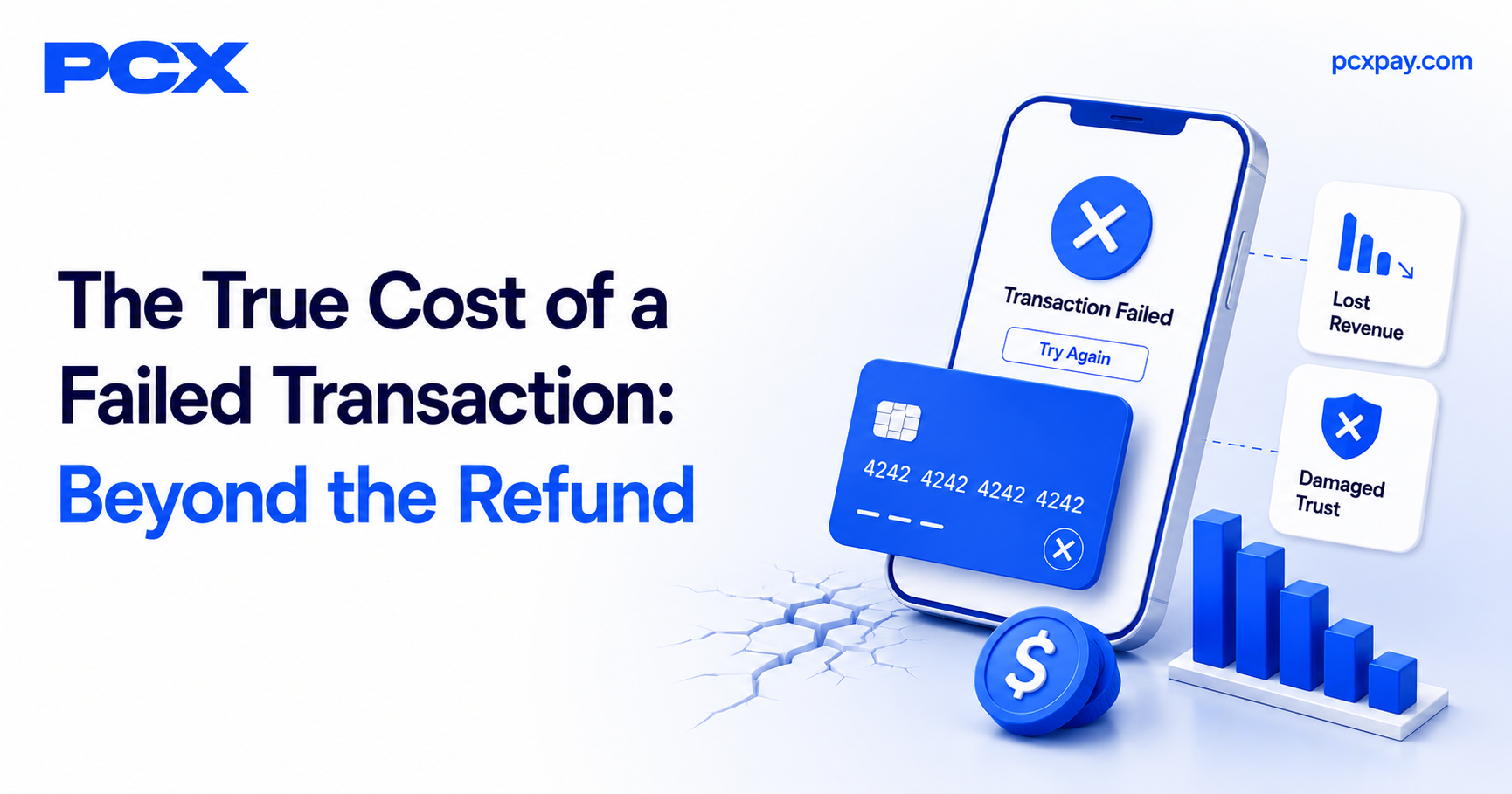
The True Cost of a Failed Transaction: Beyond the Refund

Thursday, 16 July 2026|2 mins. read
The True Cost of a Failed Transaction: Beyond the Refund
The Operational Chain Reaction Behind a Failed Payment

A single failed transaction can trigger multiple layers of internal work before the issue is truly resolved.

Support teams investigate whether funds were debited, pending, reversed, or partially settled. Finance teams reconcile mismatched balances across ledgers and providers. Engineering teams trace logs across payment rails, banking partners, and internal services to identify where the breakdown occurred. In cross-border environments, transaction states may remain inconsistent across systems for hours before final settlement visibility becomes clear.

The actual payment failure may last seconds.

The operational cleanup can last days.

This becomes especially expensive in high-volume systems where even a small percentage of failed payments creates continuous operational drag. A platform processing thousands of daily transactions may quietly spend dozens of hours weekly resolving settlement ambiguity, handling reversals, and manually validating payment states across fragmented systems.

Most companies measure refund exposure.

Far fewer measure the infrastructure cost of uncertainty.

Why Failed Transactions Become a Retention Problem

Users rarely think about payment infrastructure until something goes wrong.

When money moves predictably, the experience disappears into the background. But when a transaction fails without clear visibility or communication, trust weakens quickly. Users begin retrying payments unnecessarily, contacting support repeatedly, or abandoning transactions altogether.

In embedded finance environments, the consequences become even more significant. A failed payroll transfer, delayed vendor payout, or interrupted loan disbursement affects more than convenience. It disrupts workflows users depend on operationally.

Over time, repeated payment friction creates secondary business costs:

higher support volume,

lower transaction frequency,

reduced customer confidence,

and increased churn risk.

These effects rarely appear immediately in dashboards, but they accumulate quietly beneath the surface of growth metrics.

Reliability Is More Than Transaction Success

Many providers frame reliability as a transaction approval problem. In reality, resilient payment infrastructure depends just as much on visibility, traceability, and recovery behaviour when failures occur.

At PCXPay, infrastructure is designed around coordinated transaction monitoring across routing, settlement, reconciliation, and payout layers. This allows payment states to remain visible even when external rails, banking partners, or settlement timelines become inconsistent.

The objective is not to create the illusion that failures never happen. In payments, failures are inevitable.

The objective is to prevent failures from turning into operational chaos.

Learn how PCXPay helps platforms reduce operational payment risk through infrastructure designed for transaction observability, settlement clarity, and resilient payment orchestration.

#fintech#paymentorchestration#financialoperations#systemdesign#embeddedfinance

Other Stories

The Real Reason Cross-Border Fintech Expansions Stall (It's Not Regulation)

The Real Reason Cross-Border Fintech Expansions Stall (It's Not Regulation)

When fintech expansions fail, regulation usually gets blamed first. Licensing complexity. Compliance requirements. Cross-border restrictions. Those challenges are real. But they are rarely the primary reason expansion stalls. More often, the real problem is operational fragmentation hidden beneath the surface. Because expanding into a new market is not just a regulatory exercise. It is an infrastructure stress test.

Friday, 10 July 2026

Read More
The Compliance Debt Problem: Why KYB/KYC Shortcuts Become Infrastructure Crises Later

The Compliance Debt Problem: Why KYB/KYC Shortcuts Become Infrastructure Crises Later

Compliance shortcuts rarely feel dangerous in the beginning. A few onboarding checks are deferred to improve conversion. Verification thresholds are relaxed to accelerate growth. Manual reviews are postponed because volumes still seem manageable. At an early stage, these decisions often feel practical. Then the platform scales. More users onboard. Transaction volume increases. New markets introduce additional regulatory requirements. Suddenly, systems designed for speed begin colliding with systems that require accountability. What looked like a temporary shortcut becomes long-term infrastructure debt.

Wednesday, 1 July 2026

Read More
The Reconciliation Tax: How Much Your Finance Team Really Spends on Payment Matching

The Reconciliation Tax: How Much Your Finance Team Really Spends on Payment Matching

Reconciliation problems rarely appear on a company roadmap. No founder says, "This year, we need to spend more time matching transactions manually." Yet as payment volumes grow, reconciliation quietly becomes one of the most expensive operational inefficiencies inside modern platforms. At first, the process feels manageable. Payments come in, someone checks references, balances are updated, and the finance team moves on. But scale changes the economics completely. More users. More payment channels. More currencies. More settlement timelines. Suddenly, finance teams are no longer closing books. They are investigating transactions.

Sunday, 28 June 2026

Read More
Embedded Finance for Non-Fintechs: What SaaS and Marketplace Founders Need to Know Before They Start

Embedded Finance for Non-Fintechs: What SaaS and Marketplace Founders Need to Know Before They Start

Embedded finance feels like a feature until it starts behaving like infrastructure.

Wednesday, 17 June 2026

Read More
The KYC Handoff Problem: Who Owns Compliance When You're Using Embedded Finance?

The KYC Handoff Problem: Who Owns Compliance When You're Using Embedded Finance?

KYC looks straightforward on paper. A user signs up. Identity is verified. The account is approved. The platform remains compliant. But in embedded finance, that flow is rarely owned by a single system. Instead, it is distributed. The platform owns the user experience. A provider handles identity verification. A banking partner holds the account. A payment processor executes transactions. Somewhere in that chain, compliance responsibility is assumed to be handled. The problem is that assumption is often unclear.

Wednesday, 10 June 2026

Read More
How Embedded Finance Changes the Unit Economics of a B2B SaaS Business

How Embedded Finance Changes the Unit Economics of a B2B SaaS Business

B2B SaaS used to be simple to model. You acquire a customer. You charge a subscription. You manage churn. Growth is driven by pricing, retention, and distribution. Then embedded finance enters the picture. At first, it looks like an add-on. Payments, wallets, payouts. A way to improve user experience. But underneath, it reshapes the economics of the entire business. What changes is not just functionality. It is how revenue is generated, how margins behave, and how customer acquisition compounds over time.

Wednesday, 3 June 2026

Read More

Make Money Borderless

Stop building payment infrastructure. Start shipping features that matter. Join the platforms already moving money globally with PCX.