The Compliance Debt Problem: Why KYB/KYC Shortcuts Become Infrastructure Crises Later
The Problem with "Fixing It Later"
Most teams treat KYB and KYC as onboarding requirements.
In reality, they are structural components of financial infrastructure.
Every customer profile, transaction history, risk flag, and audit trail becomes interconnected over time. When verification systems are incomplete or inconsistent, those gaps spread across the entire platform.
The issue is not simply compliance exposure.
It is operational instability.
Incomplete customer records create reconciliation problems. Weak verification flows increase fraud exposure. Manual reviews expand faster than teams can manage. Data becomes fragmented across systems that were never designed to coordinate at scale.
By the time leadership decides to "clean things up", the architecture already depends on those shortcuts.
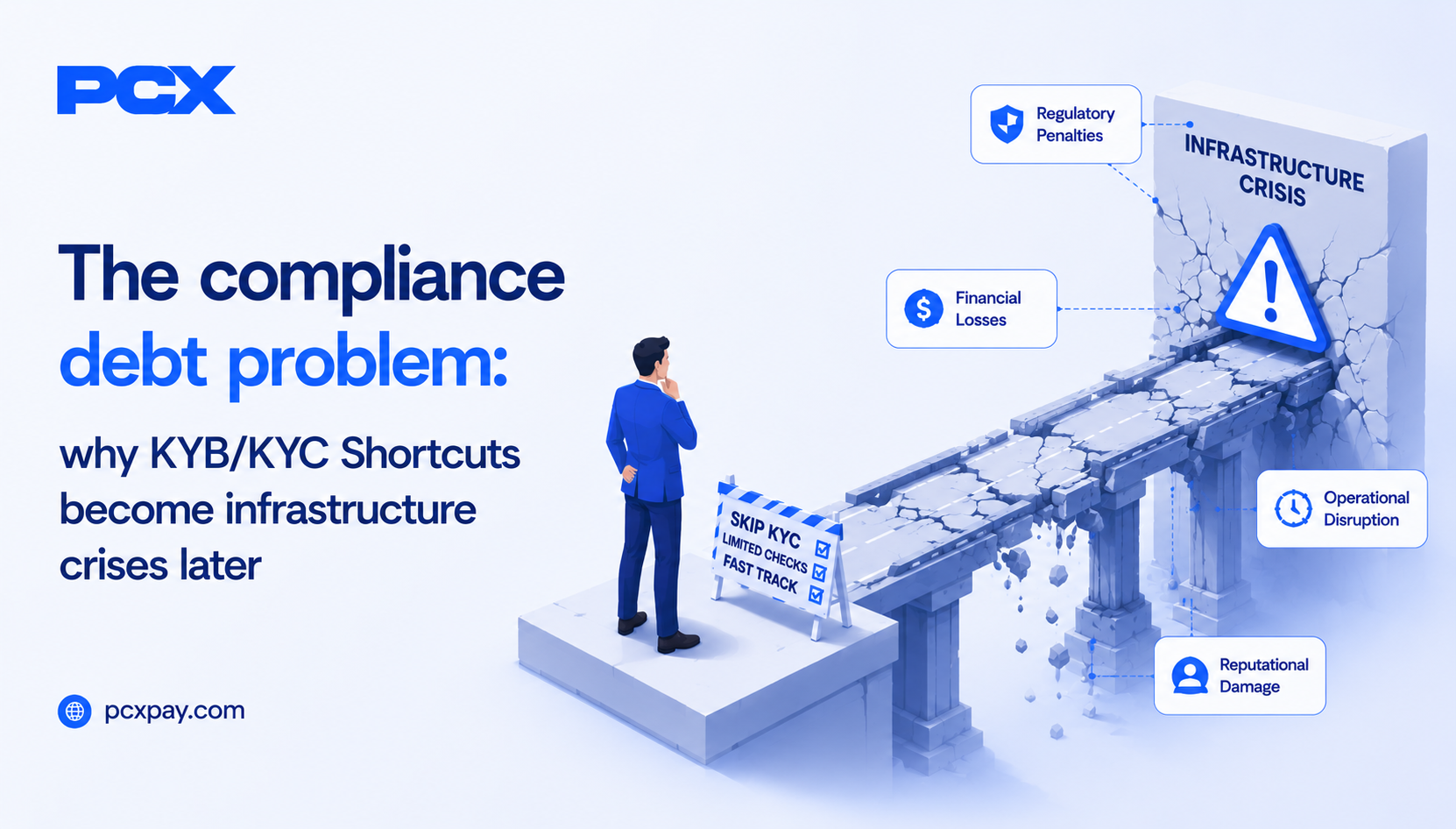
That is compliance debt.
Why Compliance Debt Behaves Like Technical Debt
Technical debt compounds because temporary decisions become embedded into production systems.
Compliance debt behaves the same way.
An onboarding flow designed without scalable verification logic eventually requires expensive redesigns. Risk systems built around manual exceptions struggle under volume pressure. Market expansion slows because customer records cannot satisfy different regulatory frameworks cleanly.
The longer shortcuts remain in production, the more expensive they become to reverse.
And unlike technical bugs, compliance failures often surface externally.
Regulators notice.
Banking partners notice.
Users notice.
The Infrastructure Layer Most Platforms Ignore
Strong compliance systems are not built through isolated checks alone.
They require coordinated architecture.
Identity verification must align with transaction monitoring. Risk signals must connect to payment behaviour. Audit records must remain consistent across onboarding, settlement, and reporting systems.
This is why modern payment infrastructure increasingly treats compliance as a product-layer behaviour rather than a standalone legal process.
At PCXPay, compliance systems are integrated directly into transaction infrastructure so verification, monitoring, and auditability remain connected throughout the payment lifecycle.
The objective is not to introduce more friction.
It is to prevent operational fragility later.
The Expansion Problem Nobody Talks About
Many fintech expansions do not slow because demand is weak.
They slow because infrastructure was never designed for regulatory variation.
A platform built around shortcuts in one jurisdiction struggles when entering another with stricter requirements. Verification flows become inconsistent. Data structures fail to support new audit standards. Internal teams spend months rebuilding systems that should have been designed correctly from the start.
Growth becomes reactive instead of scalable.
And in financial infrastructure, reactive systems rarely remain stable for long.
If your compliance workflows still depend on manual exceptions, disconnected verification systems, or reactive fixes, you may already be carrying compliance debt.
Learn how PCXPay helps platforms design scalable payment infrastructure with compliance built into the core system architecture.