Why Your Payment Provider's Uptime Claim Is Misleading
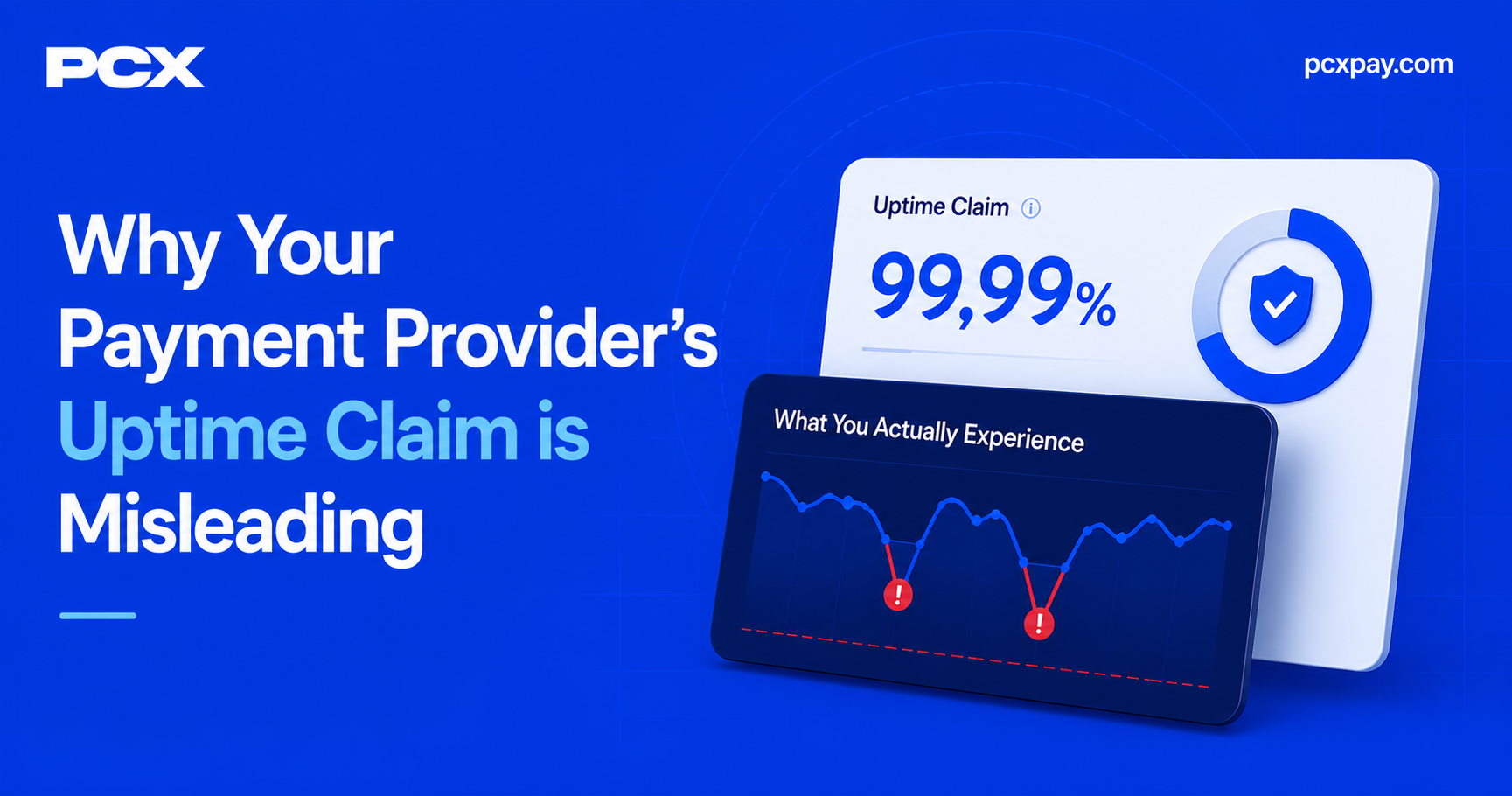
Availability and Reliability Are Not the Same Thing
Traditional uptime metrics measure infrastructure accessibility. They answer a narrow question:
"Can the system receive requests?"
What businesses actually need answered is something far more operationally important:
"Can transactions complete successfully and predictably under real conditions?"
That distinction matters significantly in modern payment environments, especially across cross-border corridors where transactions depend on multiple external systems operating simultaneously.
A provider may maintain excellent API uptime while transaction success rates fluctuate across specific regions, currencies, or banking networks. In many cases, failures happen downstream from the provider's visible infrastructure layer, long after the original API request appears successful.
Users do not experience uptime metrics.
They experience whether money arrives correctly and on time.
Why Observability Matters More at Scale
As transaction volume grows, visibility becomes just as important as uptime.
When failures occur, platforms need to understand where the breakdown happened, whether fallback routing activated correctly, and how settlement behaviour changed across dependent systems. Without transaction observability, operational teams are forced to investigate failures manually across fragmented dashboards and provider logs.
This is where resilient infrastructure separates itself from surface-level availability claims.
At PCXPay, infrastructure performance is evaluated across the full payment lifecycle rather than isolated API uptime. Routing systems continuously adapt based on partner health, settlement behaviour, liquidity conditions, and corridor performance in real time.
The focus is not simply keeping systems accessible. It is maintaining dependable transaction outcomes under changing operating conditions.
Reliability Is Measured by Outcomes
In payments, availability is only the starting point.
The systems that build long-term trust are not necessarily the ones with the highest uptime percentages. They are the systems that continue delivering predictable transaction outcomes when conditions become unstable.
Because ultimately, users do not measure reliability through dashboards or SLAs.
They measure it through whether the money arrives.
If your infrastructure evaluation still begins and ends with uptime percentages, you may be measuring the wrong layer of payment reliability.
Explore how PCXPay approaches payment infrastructure through transaction observability, adaptive routing, and resilient settlement systems designed for real-world scale.