Why Your Retry Logic is Probably Costing You Money
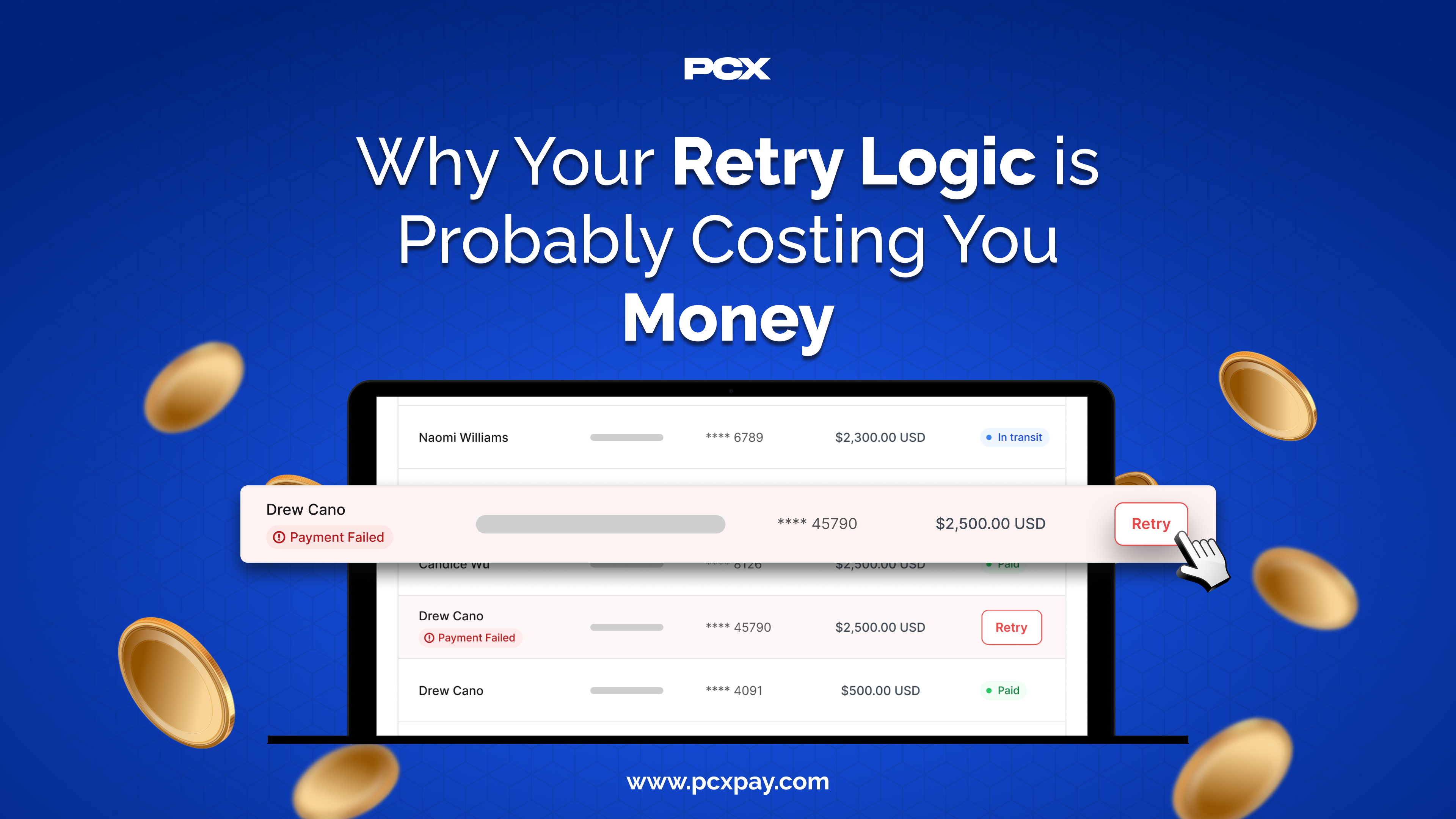
Why Basic Retry Systems Break Down
At low transaction volume, retry logic appears harmless.
A failed payment gets reprocessed a few seconds later. Most eventually succeed. Operationally, the impact feels negligible.
Scale changes the equation.
As payment flows grow across multiple banks, rails, and regions, failures stop being uniform. Some are temporary liquidity issues. Others are compliance holds, timeout inconsistencies, banking delays, or downstream settlement failures. Treating every failed transaction identically creates unnecessary traffic across systems already operating under stress.
This is where brute force retry systems begin creating operational inefficiency.
A transaction may retry repeatedly against the same unstable rail. Duplicate requests may trigger additional processing costs. Some retries succeed technically while creating reconciliation inconsistencies elsewhere in the flow.
From the outside, retry volume looks like resilience.
Underneath, it often reflects infrastructure blind spots.
Smart Routing Changes the Equation
Mature payment systems do not simply retry transactions repeatedly.
They evaluate why the failure occurred first.
This is where adaptive routing becomes significantly more important than retry frequency alone. Instead of resubmitting transactions blindly, intelligent orchestration systems analyse partner health, settlement behaviour, latency conditions, and corridor reliability in real time before determining the next routing path.
At PCXPay, retry behaviour is treated as part of a broader transaction orchestration layer rather than a standalone recovery function. Routing decisions adapt dynamically based on infrastructure conditions, reducing unnecessary retries while improving successful settlement outcomes across fragmented payment environments.
The objective is not just increasing retry attempts.
It is reducing avoidable failure cycles entirely.
Reliability Is Not About Repetition
Many infrastructure teams measure retry effectiveness through eventual success rates.
But success without efficiency creates hidden costs.
Every unnecessary retry increases operational load somewhere across the system. It affects settlement timing, observability, reconciliation complexity, and infrastructure stability under pressure. As transaction scale grows, these inefficiencies compound quietly.
Reliable payment systems are not the ones retrying the most aggressively.
They are the ones making the smartest recovery decisions.
If your retry strategy still relies heavily on static intervals or repeated requests against unstable payment paths, your infrastructure may be generating avoidable operational costs behind the scenes.
Learn how PCXPay approaches adaptive routing, transaction recovery, and payment orchestration for resilient cross-border infrastructure at scale.