What “Embedded Finance” Actually Means and What It Doesn’t

Friday, 29 May 2026|2 mins. read
What “Embedded Finance” Actually Means and What It Doesn’t
At its core, embedded finance is simple. It is the integration of financial services into a non financial product experience.

The confusion starts when integration is mistaken for ownership.

That distinction is exactly where most platforms run into problems as they scale.

The Great Divide: Integration vs Ownership

Most systems today are built on connectivity, not control.

In a standard setup, a user clicks “Pay,” your system calls an API, and the provider takes over. The transaction moves, but your platform has very little visibility or influence over what happens next.

That is integration.

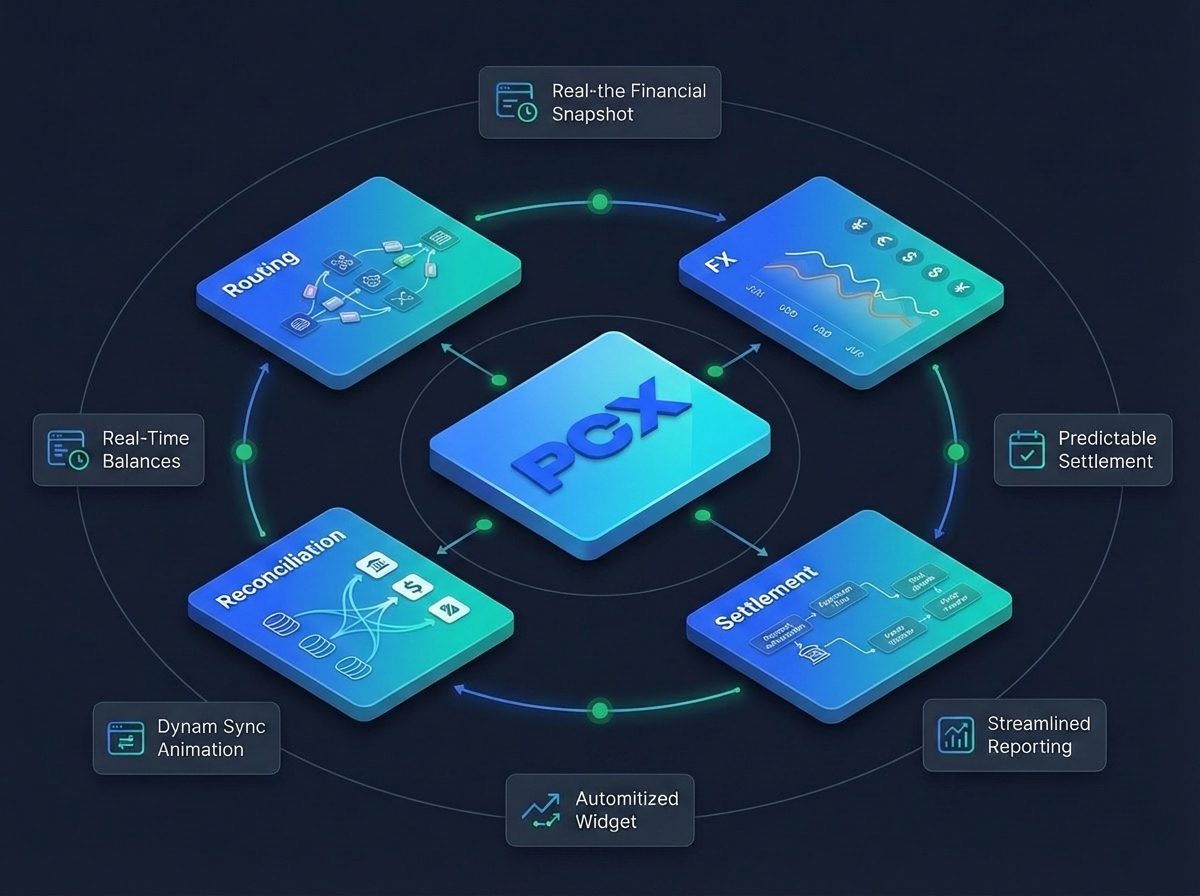
Embedded finance goes further. It requires ownership of the full transaction lifecycle. Payments, balances, FX handling, and settlement logic become part of your system, not something that happens outside of it.

At that point, you are no longer triggering requests. You are orchestrating financial flows.

That shift changes everything.

The Hidden Complexity Behind a “Simple” Payment

A single payment can involve multiple moving parts. Collection endpoints, currency conversion, compliance checks, liquidity availability, and final settlement all need to align.

For example, a cross border payout might; collect funds locally, convert currencies through an FX provider, pass through compliance screening, route across different rails, and settle in a different jurisdiction.

When these layers are loosely connected, small inconsistencies start to show.

At low volume, teams patch these gaps manually. At scale, those gaps turn into failed transactions, delayed settlements, and hours spent reconciling mismatched data.

This is where many platforms hit their first real infrastructure wall.

Why Infrastructure Determines Whether Embedded Finance Works

As transaction volume increases, finance stops behaving like a feature.

Balances need to update in real time. Settlement timelines need to be predictable. Finance teams need structured data, not fragmented reports.

If the underlying system cannot coordinate routing, FX, and settlement as one flow, complexity leaks into operations.

At PCXPay, this is the layer we focus on. Instead of treating payments as isolated API calls, we treat them as connected systems that must behave consistently across markets and volumes.

That consistency is what makes embedded finance actually work in practice.

When Finance Disappears, You Know It Works

Well designed embedded finance is not something users notice.

There are no delays to question. No missing funds to trace. No reconciliation gaps to investigate.

The system simply behaves as expected.

That outcome does not come from adding more integrations. It comes from designing infrastructure that absorbs complexity before it reaches the user or the operations team.

At that point, finance stops being something you manage.

It becomes something your product can rely on.

If your platform is starting to feel the strain of scaling payments, it may be time to move beyond basic integrations.

Learn how PCXPay helps platforms build embedded finance on infrastructure designed for consistency, control, and scale.
Other Stories

Embedded Finance for Non-Fintechs: What SaaS and Marketplace Founders Need to Know Before They Start

Embedded Finance for Non-Fintechs: What SaaS and Marketplace Founders Need to Know Before They Start

Embedded finance feels like a feature until it starts behaving like infrastructure.

Wednesday, 17 June 2026

Read More
The KYC Handoff Problem: Who Owns Compliance When You're Using Embedded Finance?

The KYC Handoff Problem: Who Owns Compliance When You're Using Embedded Finance?

KYC looks straightforward on paper. A user signs up. Identity is verified. The account is approved. The platform remains compliant. But in embedded finance, that flow is rarely owned by a single system. Instead, it is distributed. The platform owns the user experience. A provider handles identity verification. A banking partner holds the account. A payment processor executes transactions. Somewhere in that chain, compliance responsibility is assumed to be handled. The problem is that assumption is often unclear.

Wednesday, 10 June 2026

Read More
How Embedded Finance Changes the Unit Economics of a B2B SaaS Business

How Embedded Finance Changes the Unit Economics of a B2B SaaS Business

B2B SaaS used to be simple to model. You acquire a customer. You charge a subscription. You manage churn. Growth is driven by pricing, retention, and distribution. Then embedded finance enters the picture. At first, it looks like an add-on. Payments, wallets, payouts. A way to improve user experience. But underneath, it reshapes the economics of the entire business. What changes is not just functionality. It is how revenue is generated, how margins behave, and how customer acquisition compounds over time.

Wednesday, 3 June 2026

Read More
Dollarization Trends in African Markets: What It Means for Payment Platforms

Dollarization Trends in African Markets: What It Means for Payment Platforms

Across multiple African markets, a quiet shift is happening. Users are increasingly thinking in dollars. This is not always formal dollarization. In many cases, local currencies remain the primary medium of exchange. But for savings, pricing benchmarks, cross-border transactions, and large-value transfers, USD has become the reference point. For payment platforms, this shift introduces a new layer of complexity that cannot be ignored.

Friday, 29 May 2026

Read More
Mobile Money Is Not a Single Rail: Understanding the Fragmentation Across Africa

Mobile Money Is Not a Single Rail: Understanding the Fragmentation Across Africa

“Mobile money” sounds like a unified system. It isn’t. From the outside, it appears simple. A user selects mobile money, enters a number, and funds move. But underneath that single interface sits a fragmented network of providers, regulators, settlement models, and technical constraints that vary significantly across markets. The assumption that mobile money behaves like a standard payment rail is one of the most common mistakes platforms make when expanding across Africa.

Friday, 29 May 2026

Read More
Why African B2B Fintech Infrastructure Is Harder to Build Than It Looks

Why African B2B Fintech Infrastructure Is Harder to Build Than It Looks

At a glance, building fintech infrastructure in Africa can seem straightforward. Payments are growing, digital adoption is increasing, and demand is clear across multiple markets. But once you move beyond surface level assumptions, the reality becomes more complex. What works in one country often breaks in another. What looks like a simple integration quickly turns into a network of dependencies. And what feels like a product challenge is, in most cases, an infrastructure constraint.

Friday, 29 May 2026

Read More

Make Money Borderless

Stop building payment infrastructure. Start shipping features that matter. Join the platforms already moving money globally with PCX.