Build vs. Buy: The Real Cost of Payments Infrastructure for Startups

Friday, 29 May 2026|2 mins. read
Build vs. Buy: The Real Cost of Payments Infrastructure for Startups
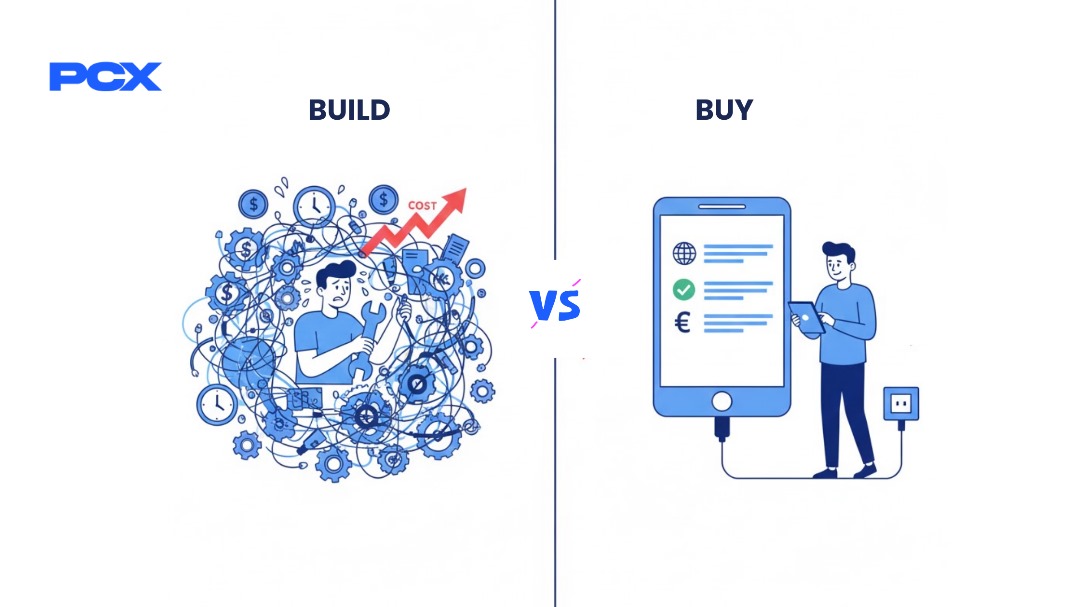
The Hidden Costs of Building Payments In-House

Building payments infra isn’t just about writing code. It means:

  • Securing licenses across multiple markets.
  • Managing compliance frameworks that shift country by country.
  • Staffing a dedicated financial operations team.
  • Diverting engineering hours away from your core product.

For most startups, these costs aren’t just high — they’re unpredictable. Delays in licensing or compliance alone can derail a launch timeline by months or even years.

Why Infrastructure Spend Is Strategic, Not Just Technical

Payments infrastructure isn’t plumbing you set and forget. It directly impacts your ability to grow across borders, manage treasury efficiently, and maintain customer trust.

  • Settlement speed affects cash flow and supplier relationships.
  • FX transparency influences pricing strategy.
  • Reliability in cross-border corridors shapes customer experience.

Choosing to build or buy isn’t just a tech decision — it’s a business strategy.

The Opportunity Cost of Building

Every hour your engineers spend on compliance logic or reconciliation systems is an hour not spent improving the product your customers actually care about. For early-stage startups, this trade-off can be fatal. Competitors that focus on customer experience while outsourcing payments scale faster, fundraise easier, and retain users more effectively.

When Building Might Make Sense

There are rare cases where building is the right move:

  • Very large fintechs with the scale to justify owning licensing and compliance in-house.
  • Companies where payments are the product, not just a feature.

For everyone else, building becomes a distraction that burns time and capital.

Why Buying (or Partnering) Wins More Often

Buying doesn’t mean giving up control. It means leveraging infrastructure that’s already licensed, compliant, and battle-tested while keeping your team focused on what makes your product unique. With modern APIs, integrating payments doesn’t take years. It takes weeks.

And critically, buying turns a fixed cost into a variable one. Instead of hiring full compliance and treasury teams, you pay per transaction and scale as you grow.

The Bottom Line

Founders should treat payments infrastructure as a strategic choice. Build only if payments are your core business. Otherwise, partner with infrastructure providers who have already solved the hard problems.

In today’s global market, speed and focus win. Don’t let building the rails slow you down when the real opportunity lies in what you build on top of them.

That’s where PCX comes in. One integration gives you licensed, compliant, multi-rail coverage across key global corridors so your team can focus on growth while we handle the infrastructure.
Other Stories

Embedded Finance for Non-Fintechs: What SaaS and Marketplace Founders Need to Know Before They Start

Embedded Finance for Non-Fintechs: What SaaS and Marketplace Founders Need to Know Before They Start

Embedded finance feels like a feature until it starts behaving like infrastructure.

Wednesday, 17 June 2026

Read More
The KYC Handoff Problem: Who Owns Compliance When You're Using Embedded Finance?

The KYC Handoff Problem: Who Owns Compliance When You're Using Embedded Finance?

KYC looks straightforward on paper. A user signs up. Identity is verified. The account is approved. The platform remains compliant. But in embedded finance, that flow is rarely owned by a single system. Instead, it is distributed. The platform owns the user experience. A provider handles identity verification. A banking partner holds the account. A payment processor executes transactions. Somewhere in that chain, compliance responsibility is assumed to be handled. The problem is that assumption is often unclear.

Wednesday, 10 June 2026

Read More
How Embedded Finance Changes the Unit Economics of a B2B SaaS Business

How Embedded Finance Changes the Unit Economics of a B2B SaaS Business

B2B SaaS used to be simple to model. You acquire a customer. You charge a subscription. You manage churn. Growth is driven by pricing, retention, and distribution. Then embedded finance enters the picture. At first, it looks like an add-on. Payments, wallets, payouts. A way to improve user experience. But underneath, it reshapes the economics of the entire business. What changes is not just functionality. It is how revenue is generated, how margins behave, and how customer acquisition compounds over time.

Wednesday, 3 June 2026

Read More
Dollarization Trends in African Markets: What It Means for Payment Platforms

Dollarization Trends in African Markets: What It Means for Payment Platforms

Across multiple African markets, a quiet shift is happening. Users are increasingly thinking in dollars. This is not always formal dollarization. In many cases, local currencies remain the primary medium of exchange. But for savings, pricing benchmarks, cross-border transactions, and large-value transfers, USD has become the reference point. For payment platforms, this shift introduces a new layer of complexity that cannot be ignored.

Friday, 29 May 2026

Read More
Mobile Money Is Not a Single Rail: Understanding the Fragmentation Across Africa

Mobile Money Is Not a Single Rail: Understanding the Fragmentation Across Africa

“Mobile money” sounds like a unified system. It isn’t. From the outside, it appears simple. A user selects mobile money, enters a number, and funds move. But underneath that single interface sits a fragmented network of providers, regulators, settlement models, and technical constraints that vary significantly across markets. The assumption that mobile money behaves like a standard payment rail is one of the most common mistakes platforms make when expanding across Africa.

Friday, 29 May 2026

Read More
Why African B2B Fintech Infrastructure Is Harder to Build Than It Looks

Why African B2B Fintech Infrastructure Is Harder to Build Than It Looks

At a glance, building fintech infrastructure in Africa can seem straightforward. Payments are growing, digital adoption is increasing, and demand is clear across multiple markets. But once you move beyond surface level assumptions, the reality becomes more complex. What works in one country often breaks in another. What looks like a simple integration quickly turns into a network of dependencies. And what feels like a product challenge is, in most cases, an infrastructure constraint.

Friday, 29 May 2026

Read More

Make Money Borderless

Stop building payment infrastructure. Start shipping features that matter. Join the platforms already moving money globally with PCX.