Collections become an infrastructure problem at platform scale

Friday, 29 May 2026|2 mins. read
Collections become an infrastructure problem at platform scale
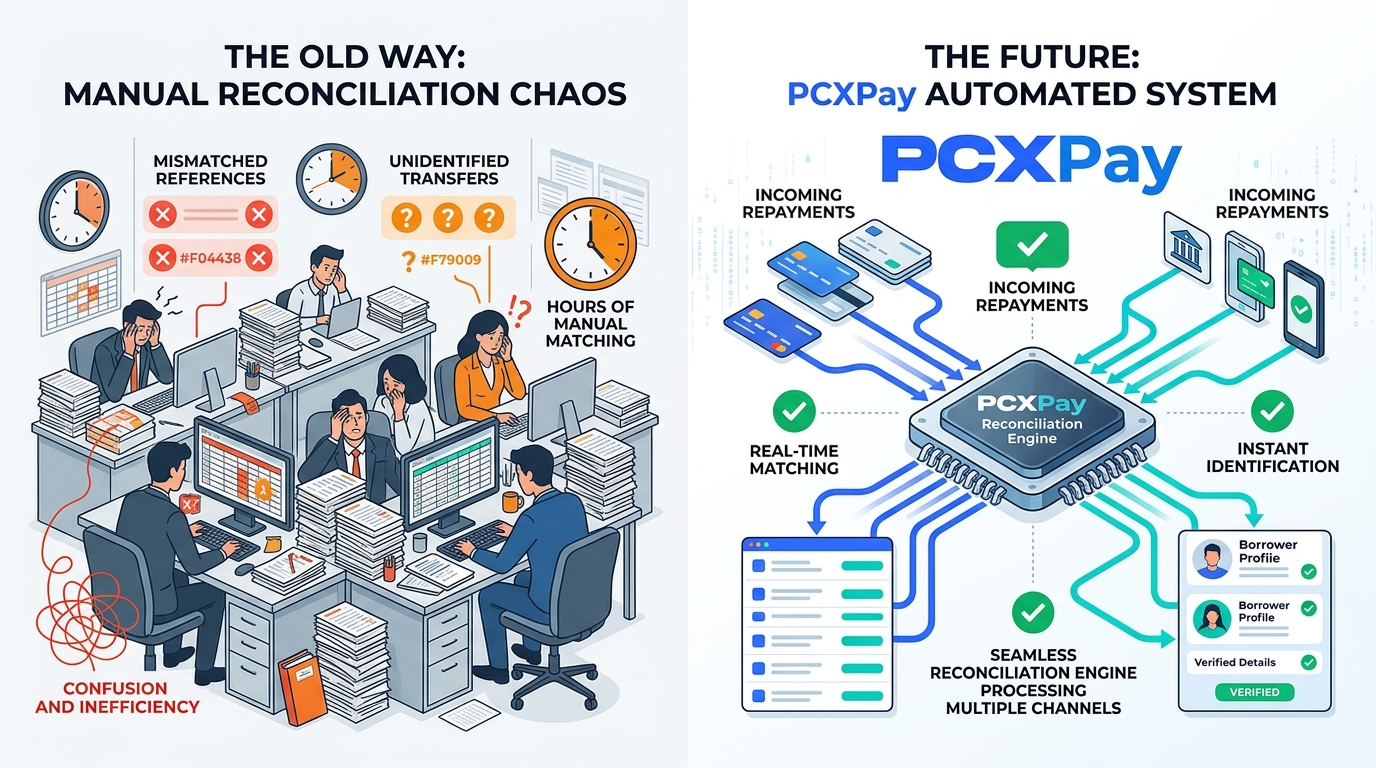
Platforms invest heavily in making loan approvals faster, onboarding smoother, and payouts instant. But what truly determines the long term health of a lending business is not how quickly money goes out.

It is how reliably it comes back in.

At small scale, repayment tracking feels manageable. A few reminders. Manual matching. Spreadsheet oversight. Teams can monitor incoming transfers and reconcile them without too much strain.

Then growth accelerates.

Hundreds or thousands of borrowers begin repaying across different banks, channels, and currencies. Payment references are inconsistent. Some repayments arrive late. Others arrive without clear identifiers. Reconciliation becomes time consuming and error prone.

Liquidity planning becomes uncertain.

When Collections Become a Liquidity Risk

Unpredictable repayments create operational instability.

Treasury teams cannot confidently forecast inflows.

New loan disbursements are delayed due to cash flow uncertainty.

Investor reporting becomes reactive instead of structured.

Staff spend hours manually tracking and matching payments.

Borrowers who attempt to repay but do not see confirmation quickly begin to question the system. Support requests increase. Trust weakens.

The real risk is not missed payments alone.

It is unpredictability.

Embedded finance platforms do not fail because they cannot lend. They struggle when they cannot reliably collect.

Why Collections Must Be Infrastructure Driven

Automated loan collection is not just about sending reminders. It is about connecting repayment channels directly into reconciliation, settlement, and treasury systems.

At PCXPay, automated loan collection rails integrate repayment methods into a coordinated backend infrastructure. Incoming payments are automatically identified, matched in real time, and reflected instantly within platform systems.

This means:

Repayments are linked to the correct borrower immediately

Balances update without manual intervention

Treasury dashboards reflect accurate inflows

Liquidity forecasting becomes structured

Collections move from reactive chasing to predictable financial management.

The Operational and Strategic Impact

Consider a growing lending platform expanding across multiple regions. Without automated infrastructure, each new market introduces additional repayment complexity.

With PCXPay, collections scale without multiplying manual processes. Liquidity becomes visible. Disbursements can be scheduled confidently. Investors gain confidence in the platform’s financial stability.

Borrowers benefit as well. When repayments are acknowledged instantly and balances reflect accurately, trust strengthens. The repayment experience feels clear and controlled.

Liquidity is not sustained by disbursement speed alone. It is sustained by repayment predictability.

At PCXPay, automated collection infrastructure transforms loan repayments into structured cash flow. That predictability supports growth, protects liquidity, and builds long term stability in embedded finance platforms.
Other Stories

Embedded Finance for Non-Fintechs: What SaaS and Marketplace Founders Need to Know Before They Start

Embedded Finance for Non-Fintechs: What SaaS and Marketplace Founders Need to Know Before They Start

Embedded finance feels like a feature until it starts behaving like infrastructure.

Wednesday, 17 June 2026

Read More
The KYC Handoff Problem: Who Owns Compliance When You're Using Embedded Finance?

The KYC Handoff Problem: Who Owns Compliance When You're Using Embedded Finance?

KYC looks straightforward on paper. A user signs up. Identity is verified. The account is approved. The platform remains compliant. But in embedded finance, that flow is rarely owned by a single system. Instead, it is distributed. The platform owns the user experience. A provider handles identity verification. A banking partner holds the account. A payment processor executes transactions. Somewhere in that chain, compliance responsibility is assumed to be handled. The problem is that assumption is often unclear.

Wednesday, 10 June 2026

Read More
How Embedded Finance Changes the Unit Economics of a B2B SaaS Business

How Embedded Finance Changes the Unit Economics of a B2B SaaS Business

B2B SaaS used to be simple to model. You acquire a customer. You charge a subscription. You manage churn. Growth is driven by pricing, retention, and distribution. Then embedded finance enters the picture. At first, it looks like an add-on. Payments, wallets, payouts. A way to improve user experience. But underneath, it reshapes the economics of the entire business. What changes is not just functionality. It is how revenue is generated, how margins behave, and how customer acquisition compounds over time.

Wednesday, 3 June 2026

Read More
Dollarization Trends in African Markets: What It Means for Payment Platforms

Dollarization Trends in African Markets: What It Means for Payment Platforms

Across multiple African markets, a quiet shift is happening. Users are increasingly thinking in dollars. This is not always formal dollarization. In many cases, local currencies remain the primary medium of exchange. But for savings, pricing benchmarks, cross-border transactions, and large-value transfers, USD has become the reference point. For payment platforms, this shift introduces a new layer of complexity that cannot be ignored.

Friday, 29 May 2026

Read More
Mobile Money Is Not a Single Rail: Understanding the Fragmentation Across Africa

Mobile Money Is Not a Single Rail: Understanding the Fragmentation Across Africa

“Mobile money” sounds like a unified system. It isn’t. From the outside, it appears simple. A user selects mobile money, enters a number, and funds move. But underneath that single interface sits a fragmented network of providers, regulators, settlement models, and technical constraints that vary significantly across markets. The assumption that mobile money behaves like a standard payment rail is one of the most common mistakes platforms make when expanding across Africa.

Friday, 29 May 2026

Read More
Why African B2B Fintech Infrastructure Is Harder to Build Than It Looks

Why African B2B Fintech Infrastructure Is Harder to Build Than It Looks

At a glance, building fintech infrastructure in Africa can seem straightforward. Payments are growing, digital adoption is increasing, and demand is clear across multiple markets. But once you move beyond surface level assumptions, the reality becomes more complex. What works in one country often breaks in another. What looks like a simple integration quickly turns into a network of dependencies. And what feels like a product challenge is, in most cases, an infrastructure constraint.

Friday, 29 May 2026

Read More

Make Money Borderless

Stop building payment infrastructure. Start shipping features that matter. Join the platforms already moving money globally with PCX.