Mobile Money Is Not a Single Rail: Understanding the Fragmentation Across Africa

Friday, 29 May 2026|2 mins. read
Mobile Money Is Not a Single Rail: Understanding the Fragmentation Across Africa
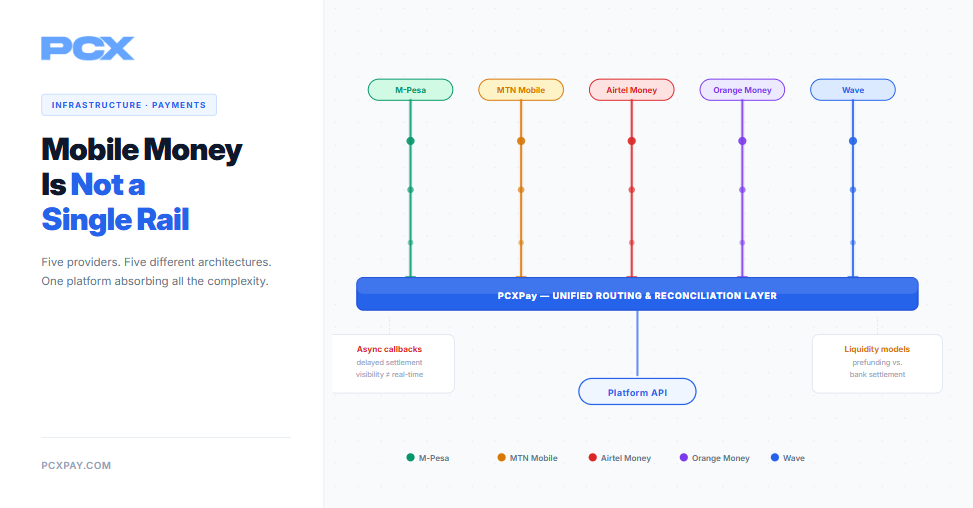
The Illusion of Uniformity

It is easy to assume that if one mobile money integration works in one country, it will work everywhere else. The reality is more complex.

MTN in Ghana operates differently from MTN in Nigeria. Safaricom’s M-Pesa has its own architecture, regulatory framework, and settlement behavior.

These are not variations of the same rail. They are entirely different systems that happen to share a similar user experience.

Each one comes with its own API behavior, failure modes, reconciliation logic, and compliance requirements. Treating them as interchangeable leads to brittle integrations and inconsistent user outcomes.

Where the Real Complexity Lives

The complexity is not at the interface level. It sits deeper in the infrastructure.

Transaction confirmation is not always real time. Some providers operate on asynchronous callbacks that may delay final settlement visibility. Others require polling mechanisms or manual reconciliation fallbacks.

Liquidity management also varies. In some markets, wallet prefunding is required. In others, settlement depends on banking partner availability. This directly impacts whether a transaction can be completed instantly or must wait.

Regulatory expectations differ as well. KYC thresholds, transaction limits, and reporting requirements are not standardized. What passes compliance in one country may be rejected in another.

For engineering teams, this means a single “mobile money integration” is actually a collection of country-specific systems that must be handled independently, even if abstracted at the product layer.

Why This Breaks at Scale

At low volume, these differences can be managed manually. Teams monitor transactions, handle exceptions, and reconcile inconsistencies in the background.

At scale, that approach collapses.

Failed callbacks, delayed settlements, and mismatched transaction states begin to accumulate. Support tickets increase. Finance teams lose visibility. Engineering teams spend more time debugging edge cases than building product features.

What looked like one rail becomes multiple operational risks.

Designing for Fragmentation

Reliable mobile money infrastructure starts with accepting that fragmentation is permanent.

At PCXPay, mobile money is treated as a set of distinct rails connected through a unified routing and reconciliation layer. Each provider is integrated with awareness of its specific behavior, not abstracted away blindly.

This allows transactions to be routed intelligently, retries to be handled based on provider characteristics, and settlement to be tracked with clarity across markets.

The goal is not to simplify the underlying systems. It is to absorb their complexity so that platforms do not have to manage it directly.

If your platform is expanding across African markets, the question is not whether you support mobile money. It is whether your infrastructure understands how different each “mobile money” rail actually is.

Learn how PCXPay unifies fragmented payment rails into a single, reliable infrastructure layer for African markets.
Other Stories

Embedded Finance for Non-Fintechs: What SaaS and Marketplace Founders Need to Know Before They Start

Embedded Finance for Non-Fintechs: What SaaS and Marketplace Founders Need to Know Before They Start

Embedded finance feels like a feature until it starts behaving like infrastructure.

Wednesday, 17 June 2026

Read More
The KYC Handoff Problem: Who Owns Compliance When You're Using Embedded Finance?

The KYC Handoff Problem: Who Owns Compliance When You're Using Embedded Finance?

KYC looks straightforward on paper. A user signs up. Identity is verified. The account is approved. The platform remains compliant. But in embedded finance, that flow is rarely owned by a single system. Instead, it is distributed. The platform owns the user experience. A provider handles identity verification. A banking partner holds the account. A payment processor executes transactions. Somewhere in that chain, compliance responsibility is assumed to be handled. The problem is that assumption is often unclear.

Wednesday, 10 June 2026

Read More
How Embedded Finance Changes the Unit Economics of a B2B SaaS Business

How Embedded Finance Changes the Unit Economics of a B2B SaaS Business

B2B SaaS used to be simple to model. You acquire a customer. You charge a subscription. You manage churn. Growth is driven by pricing, retention, and distribution. Then embedded finance enters the picture. At first, it looks like an add-on. Payments, wallets, payouts. A way to improve user experience. But underneath, it reshapes the economics of the entire business. What changes is not just functionality. It is how revenue is generated, how margins behave, and how customer acquisition compounds over time.

Wednesday, 3 June 2026

Read More
Dollarization Trends in African Markets: What It Means for Payment Platforms

Dollarization Trends in African Markets: What It Means for Payment Platforms

Across multiple African markets, a quiet shift is happening. Users are increasingly thinking in dollars. This is not always formal dollarization. In many cases, local currencies remain the primary medium of exchange. But for savings, pricing benchmarks, cross-border transactions, and large-value transfers, USD has become the reference point. For payment platforms, this shift introduces a new layer of complexity that cannot be ignored.

Friday, 29 May 2026

Read More
Why African B2B Fintech Infrastructure Is Harder to Build Than It Looks

Why African B2B Fintech Infrastructure Is Harder to Build Than It Looks

At a glance, building fintech infrastructure in Africa can seem straightforward. Payments are growing, digital adoption is increasing, and demand is clear across multiple markets. But once you move beyond surface level assumptions, the reality becomes more complex. What works in one country often breaks in another. What looks like a simple integration quickly turns into a network of dependencies. And what feels like a product challenge is, in most cases, an infrastructure constraint.

Friday, 29 May 2026

Read More
PCXPay Joins the Circle Alliance Program And Here's What That Means for You

PCXPay Joins the Circle Alliance Program And Here's What That Means for You

Friday, 29 May 2026

Read More

Make Money Borderless

Stop building payment infrastructure. Start shipping features that matter. Join the platforms already moving money globally with PCX.