Predictability Matters More Than Speed in Embedded Finance

Friday, 29 May 2026|1 mins. read
Predictability Matters More Than Speed in Embedded Finance
The Hidden Risk Behind the Speed Obsession

For a growing platform managing payroll flows, merchant settlements, subscription payouts, or cross border disbursements, speed without consistency creates operational instability.

If payments arrive instantly most of the time but occasionally fail or settle unpredictably, finance teams cannot forecast liquidity accurately. Treasury planning becomes reactive. Support tickets increase. Vendors start asking questions.

For individuals, unpredictability means anxiety. For businesses, it means risk.

Embedded finance is not only about moving money fast. It is about moving money in a way that can be relied upon every single time.

A company would rather know with certainty that funds will settle tomorrow morning than hope they arrive randomly within minutes.

Consistency builds operational confidence. Speed alone does not.

Why Predictability Becomes a Strategic Advantage

As platforms scale across markets, payment flows become more complex. Each corridor introduces different banking partners, compliance requirements, FX execution layers, and settlement timelines.

Without coordinated infrastructure, these variables create inconsistency.

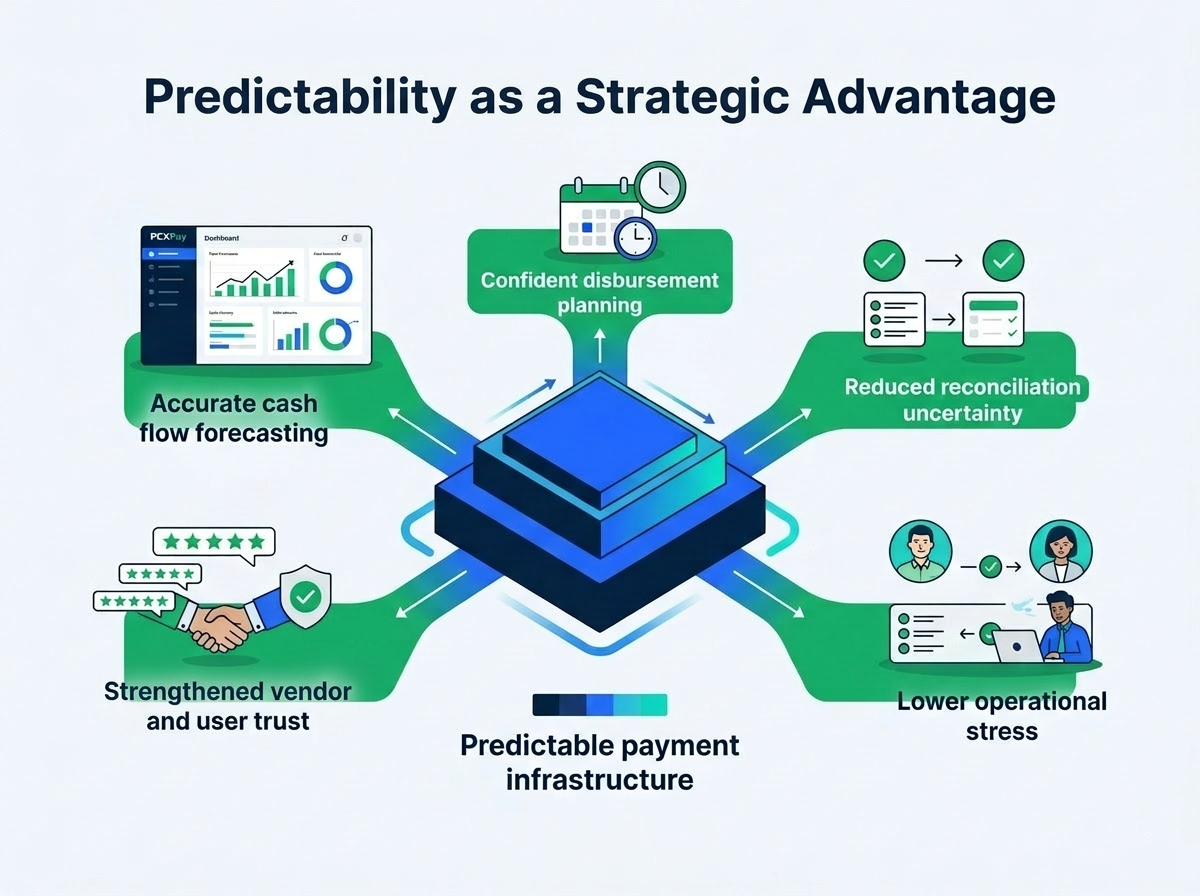
Predictable payment infrastructure allows platforms to:

Forecast cash flow accurately

Plan disbursements with confidence

Reduce reconciliation uncertainty

Lower operational stress

Strengthen vendor and user trust

Predictability reduces invisible friction. And invisible friction is what limits growth.

How PCXPay Engineers Consistency

At PCXPay, our infrastructure is designed around coordinated routing, transparent FX execution, continuous transaction monitoring, and reliable settlement behavior across corridors.

The focus is not simply accelerating transactions. It is ensuring that expected timelines are dependable.

When platforms integrate PCXPay, they gain payment rails that behave consistently across volumes and markets. That consistency supports treasury planning, operational stability, and long term scalability.

In embedded finance, speed may win headlines. Predictability wins retention.

Sustainable growth depends on infrastructure that behaves the same way tomorrow as it does today.

And that is a design decision.
Other Stories

Embedded Finance for Non-Fintechs: What SaaS and Marketplace Founders Need to Know Before They Start

Embedded Finance for Non-Fintechs: What SaaS and Marketplace Founders Need to Know Before They Start

Embedded finance feels like a feature until it starts behaving like infrastructure.

Wednesday, 17 June 2026

Read More
The KYC Handoff Problem: Who Owns Compliance When You're Using Embedded Finance?

The KYC Handoff Problem: Who Owns Compliance When You're Using Embedded Finance?

KYC looks straightforward on paper. A user signs up. Identity is verified. The account is approved. The platform remains compliant. But in embedded finance, that flow is rarely owned by a single system. Instead, it is distributed. The platform owns the user experience. A provider handles identity verification. A banking partner holds the account. A payment processor executes transactions. Somewhere in that chain, compliance responsibility is assumed to be handled. The problem is that assumption is often unclear.

Wednesday, 10 June 2026

Read More
How Embedded Finance Changes the Unit Economics of a B2B SaaS Business

How Embedded Finance Changes the Unit Economics of a B2B SaaS Business

B2B SaaS used to be simple to model. You acquire a customer. You charge a subscription. You manage churn. Growth is driven by pricing, retention, and distribution. Then embedded finance enters the picture. At first, it looks like an add-on. Payments, wallets, payouts. A way to improve user experience. But underneath, it reshapes the economics of the entire business. What changes is not just functionality. It is how revenue is generated, how margins behave, and how customer acquisition compounds over time.

Wednesday, 3 June 2026

Read More
Dollarization Trends in African Markets: What It Means for Payment Platforms

Dollarization Trends in African Markets: What It Means for Payment Platforms

Across multiple African markets, a quiet shift is happening. Users are increasingly thinking in dollars. This is not always formal dollarization. In many cases, local currencies remain the primary medium of exchange. But for savings, pricing benchmarks, cross-border transactions, and large-value transfers, USD has become the reference point. For payment platforms, this shift introduces a new layer of complexity that cannot be ignored.

Friday, 29 May 2026

Read More
Mobile Money Is Not a Single Rail: Understanding the Fragmentation Across Africa

Mobile Money Is Not a Single Rail: Understanding the Fragmentation Across Africa

“Mobile money” sounds like a unified system. It isn’t. From the outside, it appears simple. A user selects mobile money, enters a number, and funds move. But underneath that single interface sits a fragmented network of providers, regulators, settlement models, and technical constraints that vary significantly across markets. The assumption that mobile money behaves like a standard payment rail is one of the most common mistakes platforms make when expanding across Africa.

Friday, 29 May 2026

Read More
Why African B2B Fintech Infrastructure Is Harder to Build Than It Looks

Why African B2B Fintech Infrastructure Is Harder to Build Than It Looks

At a glance, building fintech infrastructure in Africa can seem straightforward. Payments are growing, digital adoption is increasing, and demand is clear across multiple markets. But once you move beyond surface level assumptions, the reality becomes more complex. What works in one country often breaks in another. What looks like a simple integration quickly turns into a network of dependencies. And what feels like a product challenge is, in most cases, an infrastructure constraint.

Friday, 29 May 2026

Read More

Make Money Borderless

Stop building payment infrastructure. Start shipping features that matter. Join the platforms already moving money globally with PCX.