Stop Guessing Who Sent You Money: How PCXPay Virtual Accounts Make Reconciliation Effortless

Friday, 29 May 2026|2 mins. read
Stop Guessing Who Sent You Money: How PCXPay Virtual Accounts Make Reconciliation Effortless
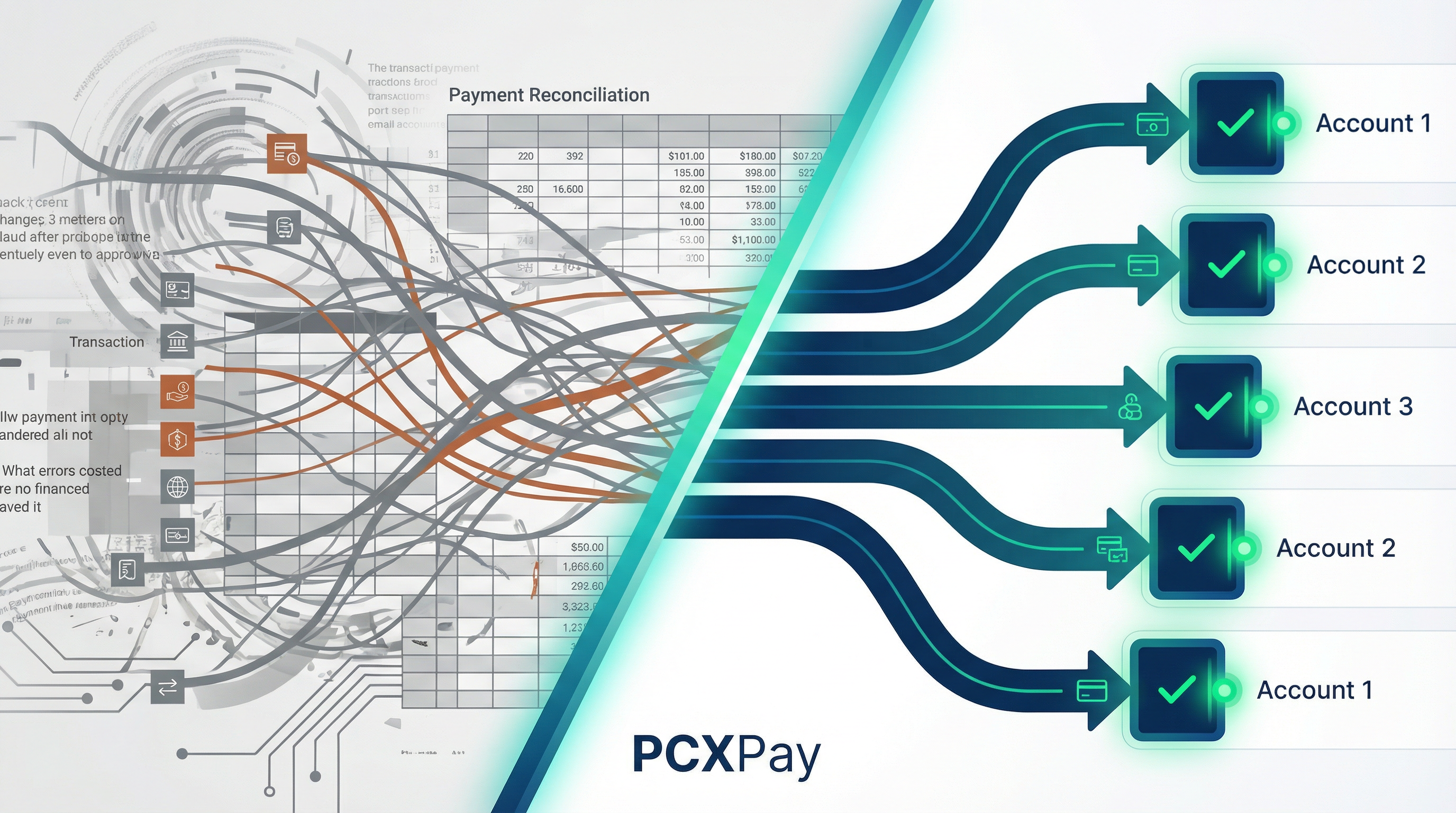
Then, the friction begins.

Suddenly, you have hundreds of users sending identical amounts with incomplete or differently formatted references. What once took minutes now consumes hours of operational time. At this stage, reconciliation quietly shifts from a background process to a massive growth bottleneck, stalling the very momentum you worked so hard to build.

The Structural Failure of Shared Collection

The fundamental flaw of shared accounts is that identification happens after the money arrives. This forces finance teams to reverse-engineer ownership, triggering “spreadsheet fatigue” and an immense operational strain. When transactions are matched manually, confirmations lag, support tickets surge, and your background processes become a daily burden.

As you expand across regions, this friction only compounds. For the user, every delay creates uncertainty: Did my payment go through? Why is it not reflected? When identification isn’t instant, trust …the most expensive currency in fintech begins to erode.

Moving from Manual Matching to Infrastructure-Led Growth

Reconciliation is an infrastructure decision, not an accounting function. If your system doesn’t identify payments at the source, growth only multiplies friction. We built PCXPay Virtual Accounts to solve this at the root.

Programmatic Assignment. By assigning unique account numbers via our API, every inflow is automatically linked to the correct ledger the moment it hits. Real-time Webhooks. Instant notifications alert your system the second a payment is successful, triggering value delivery without manual intervention. Granular Ledger Control. Even with incorrect amounts, the system identifies the sender instantly, ensuring exception handling remains an automated process rather than a manual investigation.

At PCXPay, virtual accounts integrate directly into your settlement and reporting systems. Whether you are managing ten or ten thousand repayments, every transaction is recorded instantly regardless of whether the user included a reference.

Start Scaling with Confidence. When you stop guessing who sent the money, your back office finally keeps pace with your front-end ambition.

Ready to automate? speak with our solutions team about integrating dedicated virtual accounts today.
Other Stories

Embedded Finance for Non-Fintechs: What SaaS and Marketplace Founders Need to Know Before They Start

Embedded Finance for Non-Fintechs: What SaaS and Marketplace Founders Need to Know Before They Start

Embedded finance feels like a feature until it starts behaving like infrastructure.

Wednesday, 17 June 2026

Read More
The KYC Handoff Problem: Who Owns Compliance When You're Using Embedded Finance?

The KYC Handoff Problem: Who Owns Compliance When You're Using Embedded Finance?

KYC looks straightforward on paper. A user signs up. Identity is verified. The account is approved. The platform remains compliant. But in embedded finance, that flow is rarely owned by a single system. Instead, it is distributed. The platform owns the user experience. A provider handles identity verification. A banking partner holds the account. A payment processor executes transactions. Somewhere in that chain, compliance responsibility is assumed to be handled. The problem is that assumption is often unclear.

Wednesday, 10 June 2026

Read More
How Embedded Finance Changes the Unit Economics of a B2B SaaS Business

How Embedded Finance Changes the Unit Economics of a B2B SaaS Business

B2B SaaS used to be simple to model. You acquire a customer. You charge a subscription. You manage churn. Growth is driven by pricing, retention, and distribution. Then embedded finance enters the picture. At first, it looks like an add-on. Payments, wallets, payouts. A way to improve user experience. But underneath, it reshapes the economics of the entire business. What changes is not just functionality. It is how revenue is generated, how margins behave, and how customer acquisition compounds over time.

Wednesday, 3 June 2026

Read More
Dollarization Trends in African Markets: What It Means for Payment Platforms

Dollarization Trends in African Markets: What It Means for Payment Platforms

Across multiple African markets, a quiet shift is happening. Users are increasingly thinking in dollars. This is not always formal dollarization. In many cases, local currencies remain the primary medium of exchange. But for savings, pricing benchmarks, cross-border transactions, and large-value transfers, USD has become the reference point. For payment platforms, this shift introduces a new layer of complexity that cannot be ignored.

Friday, 29 May 2026

Read More
Mobile Money Is Not a Single Rail: Understanding the Fragmentation Across Africa

Mobile Money Is Not a Single Rail: Understanding the Fragmentation Across Africa

“Mobile money” sounds like a unified system. It isn’t. From the outside, it appears simple. A user selects mobile money, enters a number, and funds move. But underneath that single interface sits a fragmented network of providers, regulators, settlement models, and technical constraints that vary significantly across markets. The assumption that mobile money behaves like a standard payment rail is one of the most common mistakes platforms make when expanding across Africa.

Friday, 29 May 2026

Read More
Why African B2B Fintech Infrastructure Is Harder to Build Than It Looks

Why African B2B Fintech Infrastructure Is Harder to Build Than It Looks

At a glance, building fintech infrastructure in Africa can seem straightforward. Payments are growing, digital adoption is increasing, and demand is clear across multiple markets. But once you move beyond surface level assumptions, the reality becomes more complex. What works in one country often breaks in another. What looks like a simple integration quickly turns into a network of dependencies. And what feels like a product challenge is, in most cases, an infrastructure constraint.

Friday, 29 May 2026

Read More

Make Money Borderless

Stop building payment infrastructure. Start shipping features that matter. Join the platforms already moving money globally with PCX.