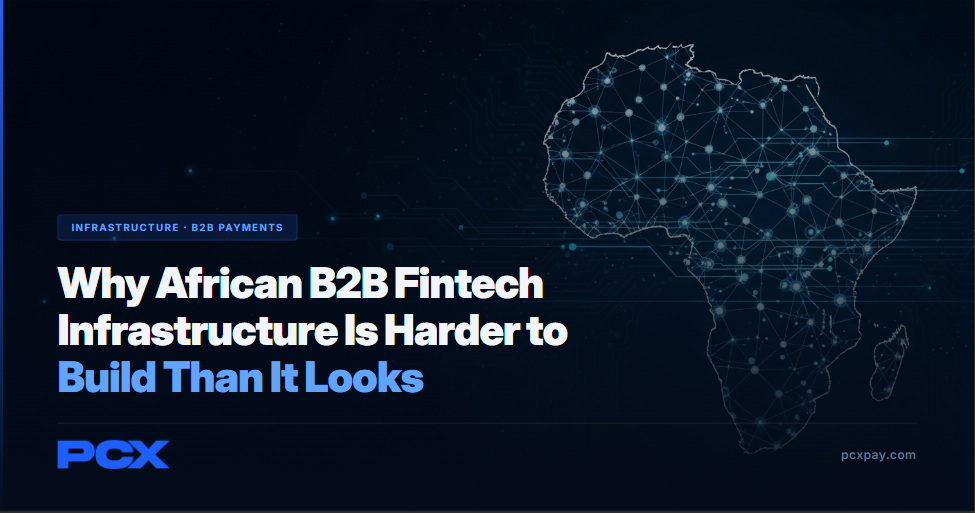
Why African B2B Fintech Infrastructure Is Harder to Build Than It Looks
The Illusion of a Single Market
Africa is often discussed as one opportunity. From an infrastructure perspective, it behaves like many.
Each market operates within its own regulatory structure, banking ecosystem, and settlement environment. Even when payment types appear similar, the systems behind them are not interchangeable.
A platform that works well in Nigeria cannot be deployed into Kenya or Ghana without significant adjustments. Compliance requirements change. Banking partners differ. Settlement timelines shift. Currency dynamics introduce new risks.
For B2B platforms, this means expansion is never just about enabling a new corridor. It requires rethinking how money moves, how it is held, and how reliably it can be delivered.
Where the Real Complexity Lives
Most of the difficulty does not appear at the integration layer. It sits beneath it.
A single B2B transaction moving across borders may pass through local collection systems, currency conversion processes, compliance checks, and multiple settlement institutions before it reaches its final destination.
Each of these layers behaves differently depending on the market. Liquidity may not always be available when needed. Settlement windows may not align. Regulatory expectations may shift without warning.
At low transaction volumes, teams can manage these inconsistencies manually. At scale, that approach breaks down.
Delays become more frequent. Reconciliation becomes harder. Engineering teams spend more time resolving edge cases than building forward.
What seemed manageable early on becomes a structural limitation.
The Weight of Banking Dependencies
In many African markets, payment infrastructure remains closely tied to local banking systems.
Access to these systems is not always direct. Platforms often depend on intermediary partners to operate across regions. This introduces additional layers between the product and the final transaction outcome.
Performance is also not uniform. Downtime, delayed settlement, and restricted operating windows are not rare occurrences. They are part of the operating environment.
For B2B platforms, this creates a different kind of engineering challenge. Reliability is no longer defined only by internal systems. It depends on how well external dependencies are understood and managed.
Why Growth Becomes an Infrastructure Problem
As platforms expand, complexity grows faster than expected.
Each new market introduces new regulatory exposure, new liquidity considerations, and new operational edge cases. Without a coordinated system, these layers do not integrate cleanly. They accumulate.
This is where many platforms begin to slow down. Not because demand is lacking, but because the infrastructure cannot support consistent execution across markets.
Growth becomes constrained by variability.
Designing for Fragmentation, Not Fighting It
The goal is not to eliminate fragmentation. It is to design systems that can operate within it.
At PCXPay, this means treating routing, FX handling, settlement, and compliance as interconnected parts of a single system. Instead of managing each layer independently, they are coordinated to behave predictably across different markets and conditions.
This approach does not simplify the environment. It makes it manageable.
And that is what allows platforms to scale without constantly rebuilding their foundations.
If you are building across African markets, the real challenge is not access. It is consistency.
Learn how PCXPay supports reliable B2B payment infrastructure designed for fragmented environments and long term scale.