Why Building Embedded Finance Infrastructure In House Rarely Pays Off
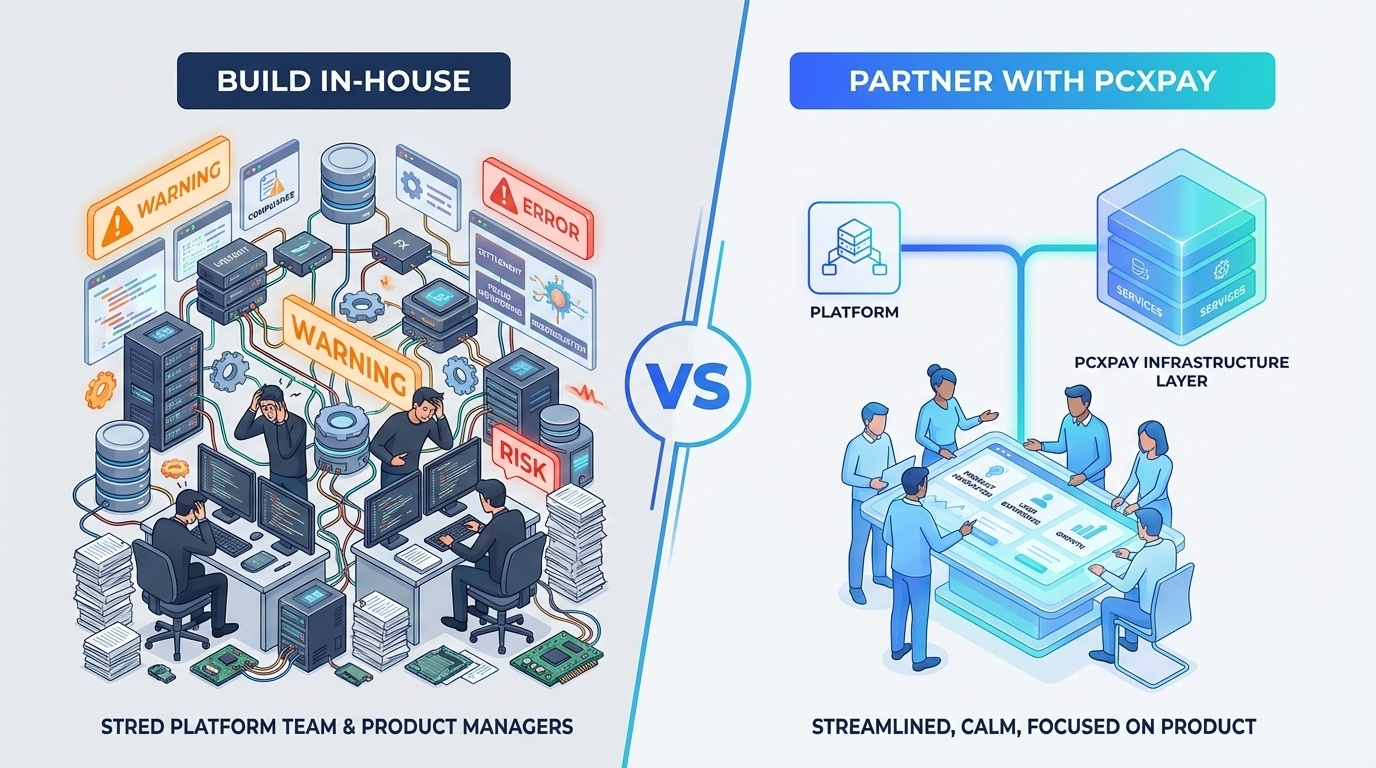
For many growing platforms, building payments infrastructure internally feels like a strategic advantage.
Control the integrations.
Own the stack.
Reduce external dependency.
At first glance, this seems logical.
But embedded finance infrastructure is deeper and more demanding than most platforms anticipate.
The Infrastructure Beneath the API
Payments are not just technical integrations. They involve regulatory compliance across jurisdictions, liquidity coordination, FX management, settlement timing logic, reconciliation systems, fraud monitoring, and continuous monitoring across corridors.
Each new market introduces legal nuance.
Each payment rail introduces operational variability.
Each increase in transaction volume increases exposure to failure points.
What begins as an integration project quickly evolves into a permanent infrastructure commitment.
Maintaining that commitment requires specialised teams, banking relationships, regulatory awareness, treasury oversight, and round the clock monitoring.
This is not a one time build. It is an ongoing operational responsibility.
The Opportunity Cost Platforms Underestimate
Engineering teams focused on payment troubleshooting are not building core product innovation.
Finance teams manually reconciling unpredictable settlement flows are not planning expansion.
Compliance teams navigating new corridors internally slow time to market.
The cost of in house infrastructure is rarely just financial. It is a strategic distraction.
As embedded finance scales, complexity compounds. Maintenance demands grow. Technical debt accumulates.
What initially feels like control gradually becomes operational drag.
Why Specialised Infrastructure Partners Create Leverage
Infrastructure providers focused exclusively on embedded finance absorb this complexity as their core responsibility.
At PCXPay, we invest in multi rail connectivity, regulatory alignment, FX optimisation, coordinated routing, settlement predictability, and redundancy planning across markets.
Platforms that partner with PCXPay gain scalable infrastructure without reallocating internal resources away from growth.
They enter new markets faster.
They reduce operational risk.
They improve settlement reliability.
They maintain focus on user experience and product differentiation.
Strategic partnership allows platforms to move faster at the product layer while relying on infrastructure designed for scale underneath.
And in embedded finance, scale is everything.